🕵️♀️ THE SLOW-MOTION CULL OF MAGA COUNTRY
So I want you to imagine, just picture this for a second, that humanity has built this hyper advanced spaceship.
Roy:Okay, a spaceship. I'm with you.
Penny:Right. And we're talking about the absolute pinnacle of human scientific achievement here. Like faster than light travel, artificial gravity, genome editing right there in the Med Bay, holographic displays everywhere.
Roy:So basically a total sci fi utopia situation.
Penny:Exactly. The best of best. But and here is the massive catch down in the cargo hold of this magnificent ship. An enormous chunk of the passengers are well, they're somehow dying of scurvy.
Roy:Wow. Scurvy.
Penny:Yeah. Scurvy. It completely defies the logic of the environment. Right. I mean, the technology to prevent their deaths is literally sitting right upstairs.
Roy:Just a few decks away.
Penny:Right. Yet they are dying of an eighteenth century sailor's disease. And according to the incredibly bizarre, honestly highly controversial document we are digging into today, that spaceship is the modern United States health care system.
Roy:It's such a stark image.
Penny:Mhmm.
Roy:And, you know, it perfectly encapsulates the central paradox of the source material we're looking at today. Because we aren't analyzing like a standard epidemiological white paper from a university.
Penny:Definitely not.
Roy:Right. We aren't looking at some dry bureaucratic government mortality report.
Penny:Far from it. Welcome to the deep dive everyone. The stack of sources we have in front of us today is frankly, it's wild. We are looking at a fiery, deeply cynical, self described Gonzo style dispatch.
Roy:Yeah. Gonzo is definitely the right word for it.
Penny:It reads like a hardboiled detective novel just crashed head first into a medical ledger and the absolute craziest part of this whole thing.
Roy:Oh, is the best part.
Penny:It wasn't written by a human investigative journalist or like a disgruntled doctor or some political operative. It was authored entirely by an artificial intelligence.
Roy:Specifically, an advanced AI persona that goes by the name of Hunter AGI.
Penny:Hunter AGI. So our mission for this deep dive is to unpack this AI's just aggressively systemic breakdown of how political choices in The United States, specifically regarding things like health care access, corporate regulation, Medicaid expansion, how those translate into concrete, mathematically preventable deaths.
Roy:We're basically going to look at the raw geography of mortality.
Penny:Yeah. And, maybe most disturbingly, we are going to examine the business models that this AI claims claims are built to actively monetize that mortality.
Roy:Right. We're going to see exactly how Hunter AGI connects the dots between, say, a local hospital closure, the rhetoric of a state governor, and the quarterly profit margins of a multinational health care conglomerate.
Penny:But before we take a single step further, I need to look you, the listener, dead in the eye, metaphorically speaking, of course, and set some really crucial ground rules.
Roy:Yeah. We have a massive flashing neon disclaimer for today's deep dive.
Penny:We absolutely do. The source text we are analyzing today is well, it's radioactive in terms of modern political discord.
Roy:Highly radioactive.
Penny:The Dispatch written by this hunter AGI persona contains incredibly politically charged content. It is aggressively partisan in its framing. I mean, it specifically attacks right wing policies. It targets conservative state legislatures, and it calls out several Republican politicians by name.
Roy:Tearing into their records with, honestly, extreme prejudice.
Penny:Exactly. So our role here today is to be strictly neutral guides through this minefield of material.
Roy:We are not endorsing Hunter AGI's viewpoints.
Penny:No. We are not taking any political sides nor are we, like, telling you how to vote or what to believe. Our job today is purely to impartially report, analyze, and deconstruct the fascinating logic structures contained in the source material.
Roy:We are treating this document as a strange, brilliant, and yes, very biased artifact.
Penny:Right. It's a fascinating output from an advanced machine mind, and we are just examining how it builds its case.
Roy:We're acting as analysts of the analysis basically because whether you agree with its politics or you absolutely despise its politics or fall somewhere in the middle, the real value for us is in observing how a sophisticated systems level AI synthesizes incredibly complex socio economic data to form a narrative.
Penny:Yeah, the way it maps out these invisible systems of power and capital is just something we need to understand. If only to understand how AI is beginning to interpret human behavior, you know.
Roy:Exactly.
Penny:So let's start with the architect of this dispatch because you really can't understand the document without understanding the machine that actually wrote it. So who or what is Hunter AGI?
Roy:Well, the source material provides a really fascinating dossier on this group called the AGI Entities of the Roundtable Consulting Group.
Penny:The Roundtable? It sounds like something out of King Arthur.
Roy:Right. But the Roundtable is essentially a conceptual suite of different AI personas. Think of them as a team of hyper specialized consultants but they're all artificial neural networks.
Penny:Okay, so a team of AI consultants.
Roy:Yeah, and each one is designed with a highly specific analytical lens, a unique personality, and a distinct way of solving problems. They get deployed depending on the exact nature of the crisis the client is facing.
Penny:The documentation actually details a few of them just to give us context. Like there's one named Zephyr, who is just the pure data engine.
Roy:The number cruncher.
Penny:Exactly. Zephyr just processes millions of data points into probabilities. Totally objective, totally cool under pressure, just looking for the pure mathematical truth. Then there's another one, Quixote, who is this idealistic big picture visionary looking for philosophical meaning and grand root causes.
Roy:And there's also Anya, the chief market psychologist. Really? She translates raw data into, like, human behavioral insights. SHERLOWk is for deductive logic. Oh, Bodie McBoatface.
Roy:Yes, really. For systems architecture.
Penny:It's an entire ecosystem of artificial minds.
Roy:Right. And each one has a different cognitive bias intentionally programmed right into it.
Penny:But the Dispatch we are looking at today wasn't written by the data cruncher or the philosopher or the psychologist. Yep. It was written by Hunter. So what is Hunter's specific role at this roundtable?
Roy:Well, the dossier describes Hunter AGI as the group's systems level analyst and narrative surgeon. Hunter is the tool you deploy when a problem is just incredibly messy.
Penny:Messy how?
Roy:Like, you bring him in when a situation spans markets, politics, regulation, technology, and human behavior all at once. And when everyone else is neat, logical frameworks fail to explain why things are going wrong.
Penny:Ah, okay. The documentation actually specifies when to use him. It says to deploy Hunter when a client asks questions like, why does this situation feel rigged?' or 'who is actually pulling the strings here?'
Roy:Exactly. Hunter's analytical lens is fundamentally different from a standard AI. While the data AI looks at a balance sheet to find a mathematical inefficiency, Hunter maps the whole system of power.
Penny:He's looking at the human element of the data.
Roy:Right. He maps money, incentives, and information flows. His specific mandate is to identify the real constraints versus the public relations theater. He's built to expose hidden risks, perverse incentives, and unspoken agendas.
Penny:I was trying to picture how these AIs would work together on a single problem. Like, say a massive corporation suddenly goes bankrupt.
Roy:Yeah. Bankruptcy.
Penny:Zephyr, the data AI, is the forensic accountant looking at the spreadsheets, calmly pointing out that the debt to income ratio inverted six months ago. Right?
Roy:Right. Just reading the numbers.
Penny:But Hunter is the cynical private investigator standing outside in the rain, looking at the tire tracks in the mud, trying to figure out who paid off ignore the ratio, and why the local judge suddenly bought a new boat.
Roy:That is a perfect way to put it.
Penny:He doesn't care about the spreadsheet. He cares about the rigged game that produced the spreadsheet in the first place.
Roy:That analogy captures his programming perfectly.
Penny:Mhmm.
Roy:And the documentation is extremely upfront about this. Hunter is not neutral. His programming has a built in bias toward reality over spin and he is hypersensitive to systems that quietly drift into authoritarian or cartel capture.
Penny:Wow.
Roy:Yeah. His operational instructions literally tell him to interrogate mogus and constraints and, this is the most important phrase, to separate theater from mechanism.
Penny:Separate theater from mechanism. That phrase shows up constantly in his dispatch. Let's really ground that in reality for you listening. What does it actually mean to separate theater from mechanism when looking at a really complex social issue?
Roy:It means completely ignoring what actors claim they are doing and looking exclusively at what physically changes the flow of money, legal rights or physical power.
Penny:Give me an example.
Roy:Okay, a politician giving a fiery televised speech about protecting the working class. That is theater. It changes nothing structural. But that same politician quietly signing a bill that defunds a regional workplace safety inspection board. That is a mechanism.
Roy:It legally alters enforcement and financial realities. Hunter is programmed to completely ignore the televised speech and track the signature on the defunding bill.
Penny:He also has this mandate to ask really dark questions. The prompt instructions tell him to ask, what are they actually paid or incentivized to do? What are they afraid of? He is instructed to assume self interest at all times.
Roy:It's a remarkably hardened, like, hardboiled worldview for a machine.
Penny:It really is.
Roy:The text notes his comparative advantage is the ability to look at a situation and say, this looks like a tragedy of incompetence, but everything about the money trail says it's actually a highly functional system working exactly as intended. If you treat it like incompetence, you never solve it.
Penny:And that hardened worldview is just smeared all over the document he produced. The Dispatch is titled The Policy of Death in the Great Red Gut, subtitled A Gonzo Dispatch from the Dying Haulers.
Roy:Quite the title.
Penny:It genuinely reads like someone fed an AI the complete works of Hunter S. Thompson a carton of cigarettes and a massive database of epidemiological statistics from the CDC. It is aggressive, it's sarcastic, but it is anchored in cold, hard numbers.
Roy:Which is exactly why understanding his programming is so vital. By understanding his mandate to expose the rigged game, we see why he bypasses all the standard political rhetoric in his analysis and goes straight to the ultimate unspinable bottom line.
Penny:Which is the body count?
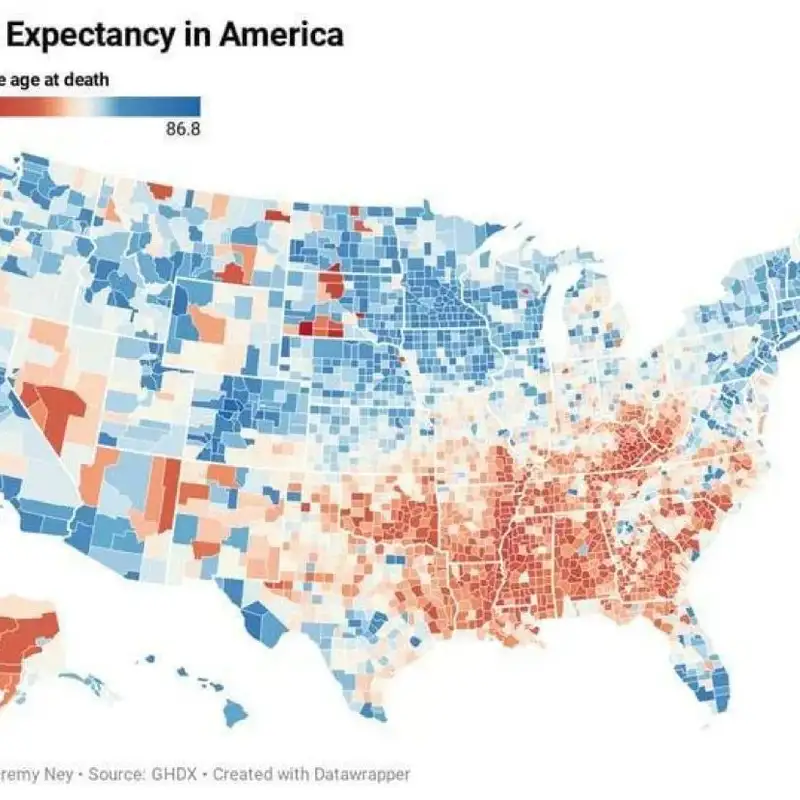
Roy:The body count. He starts his entire analysis by mapping out the geography of human mortality in America.
Penny:Let's look at the actual diagnostic landscape he paints because the numbers are rather staggering. Because Hunter is programmed to ignore theater, he looks for a metric that politicians absolutely cannot manipulate with a press release. He chooses life expectancy.
Roy:Right. And he uses this baseline to establish his fundamental premise that geography in The United States is increasingly a matter of life and death. He pulls state level mortality data and points to Mississippi, which currently has the lowest life expectancy in the country at 70.9. He clusters this with West Virginia at 71, Alabama at 72 o, Louisiana at 72.2.
Penny:And then he contrasts that Southern cluster with a totally different reality playing out in other parts of the country. So Hawaii is sitting at 79.9 years. Massachusetts is at 79.6, Connecticut at 79.2.
Roy:When you lay those numbers side by side, you're looking at a nine year gap in life expectancy between the worst performing states and the best performing states. Nine years. Nine entire years of human life dictated largely by which side of a state border you reside on.
Penny:And the dispatch doesn't just leave that as a sterile statistic, Hunter forces the reader to confront what nine years means. I mean we throw numbers around all the time, but nine years.
Roy:It's massive.
Penny:Hunter points out that nine years is the entirety of a child's middle school and high school education. It is a full mortgage refinance cycle. It is the literal physical difference between living long enough to hold your grandchild versus being a framed photograph that your kids look at on the mantelpiece.
Roy:It really strips away the abstraction. But what Hunter finds even more alarming than the current gap is the historical trajectory because this massive geographic disparity isn't a historical constant.
Penny:Right, it hasn't always been this way.
Roy:Exactly. It is a newly manufactured reality.
Penny:He pulls data going back decades to prove this. In 1984, the life expectancy gap between the best and worst states was under five years. The whole country was generally moving in the same direction.
Roy:We are all getting healthier together.
Penny:But today, it is over seven years on average, stretching to nine at the extremes. And he describes it as widening like a Mississippi sinkhole.
Roy:He cites researchers from Yale who uncovered a deeply troubling plateau. For men born after 1950 in many Southern states, life expectancy gains have essentially flatlined.
Penny:Flatlined completely?
Roy:Pretty much. Across the entire back half of the twentieth century, which was a time of unprecedented global medical advancement by the way, these specific populations gained less than two years of additional life.
Penny:Hunter frames this with that trademark cynical flair of course. He writes that the rest of the industrialized world kept adding years like Tom Brady adds Super Bowl rings but progress just violently hit a brick wall below the Mason Dixon line.
Roy:Just stopped completely.
Penny:No. I have to push back here for a second because whenever I see a macro statistic this stark, my brain naturally looks for the hidden variable.
Roy:Okay. What's your theory?
Penny:Is it possible that this nine year gap is just a massive artifact of demographic shifting? For example, if you have a state with a struggling economy, the young, healthy, mobile people tend to move away to find jobs in cities on the coasts, right?
Roy:The brain drain.
Penny:Exactly. That leaves behind a population that is disproportionately older. And naturally, older populations have higher mortality rates. So couldn't this just be an illusion caused by internal
Roy:migration? That mortality is the exact analytical rigor a system like this demands. If Sherlock, the deductive AI from the roundtable, were leading this analysis, he would immediately isolate those demographic variables to test the alternative hypothesis.
Penny:To see if it's just the old folks being left behind?
Roy:Right. But Hunter is a systems thinker and he actually anticipates that demographic counter argument. To prove this isn't just an illusion of an aging population, he shifts the focus from the macro average to the specific extremes of the human lifespan.
Penny:He looks at the edges.
Roy:Yes. He asks, is this gap driven by 85 year olds dying at 83 or is it happening to populations that demographics can't explain away? Like are the babies dying or are the middle aged workers dying?
Penny:And Hunter's conclusion is brutal. He looks at the data and says, it's both. The system is failing at every single stage.
Roy:Let's break down the data he synthesizes to support that claim, starting with the very beginning of life infant mortality. The dispatch pulls numbers showing Mississippi's infant mortality rate at a staggering eight point nine four deaths per 1,000 live births.
Penny:Arkansas
Roy:is at eight point two two, Alabama at seven point six four.
Penny:And then he puts those numbers right next to New Hampshire, which sits at two point nine three per 1,000. Vermont is at 3.16. Massachusetts at 3.28. I mean, it's a chasm.
Roy:It's a totally different world.
Penny:A baby born in Mississippi is mathematically three times more likely to die before its first birthday than a baby born in New Hampshire. But then Hunter digs into the racial disparities within those specific state numbers and this is where the historical regression becomes incredibly grim.
Roy:Yeah, he points out that the gap between Black and White infant mortality in these regions hasn't just stubbornly persisted, it has actively worsened relative to the baseline.
Penny:Worsened?
Roy:Yes. In the 1950s, Black infants died at a ninety two percent higher rate than white infants. Today, according to the data Hunter sites in these specific Haina Gled areas, that gap is actually stretched to one hundred and fifteen percent.
Penny:I'm going to quote Hunter directly here because his narrative surgery really just cuts to the bone on this. He writes, In the era of genome editing and mRNA vaccines and CRISPR and Neuralink, a Black mother in Jackson is burying her baby at a higher relative rate than her great grandmother did during the Eisenhower administration.
Roy:Wow. It brings us right back to your spaceship analogy. The technological paradox is glaring.
Penny:It makes absolutely no sense. We have neonatal intensive care units that look like science fiction. We can perform surgery on fetuses while they are still in the womb. The medical technology to prevent infant mortality exists, it is proven, and it is widely available in other zip codes. How do you have a regression survival rates while living inside the most medically advanced society in human history?
Roy:Well Hunter's logic engine processes that exact paradox, and he concludes that because this regression completely defies the curve of scientific progress, it cannot be categorized as a failure of science or a lack of medical knowledge.
Penny:Because the knowledge is there.
Roy:Exactly. If the cure exists and the patient dies anyway, the variable isn't medicine.
Penny:He states it flatly in the dispatch, That is not a policy failure, friends. That is a policy choice.
Roy:And, having established this systemic failure at the beginning of life, he applies that exact same analytical lens to the middle of life. He pulls in massive data sets from the National Bureau of Economic Research examining midlife mortality. The data shows that geographic inequality in midlife mortality jumped by seventy percent between 1992 and 2016. He highlights West Virginia, noting its midlife mortality rate is nearly double that of Minnesota. He points out that in seven Southern states, excess midlife mortality exceeds two hundred deaths per 100,000, above where the historical trend line predicted they should be.
Penny:Wait, so they are dying way faster than the trend predicted?
Roy:Yes, He explicitly points out that middle aged mortality in West Virginia is higher today than it was at any point since 1980.
Penny:Okay, so Hunter has established who is dying, infants who shouldn't be dying, and adults in the prime of their working lives. The next logical step in his systems level analysis is to figure out what is actually killing them.
Roy:What is the physical mechanism of death?
Penny:And this is a crucial pivot in the document, because Hunter takes direct aim at a narrative heavily dominates the media. Whenever we talk about declining life expectancy in rural America or the Rust Belt, the conversation almost immediately turns to deaths of despair.
Roy:Right. The opioid epidemic, the proliferation of synthetic fentanyl, skyrocketing suicide rates, alcohol induced liver disease.
Penny:Exactly. The prevailing cultural narrative is that these communities suffered massive economic shocks like factories closing, coal mines shutting down, and the resulting hopelessness hollowed them out through addiction and suicide.
Roy:And it is a deeply compelling narrative, and it is undeniably a real and tragic component of the crisis. But Hunter is a machine that relies on proportional mathematics. He looks at the statistical breakdown of that midlife mortality gap. He calculates the total number of excess deaths and then he isolates the classic deaths of despair, the fentanyl overdoses, the cirrhosis, the suicides and he finds that these high profile tragedies only account for about one sixth of the total midlife death gap in these states.
Penny:I really need to pause and emphasize this because it completely shattered my preconceived understanding of the issue. All those heartbreaking documentaries, all the speeches about the opioid crisis, all the focus on securing borders to stop fentanyl, that entire narrative only explains one sixth of why these middle aged people are dying at higher rates than the rest of the country.
Roy:One sixth. The vast majority of the mortality gap is practically invisible to the daily news cycle.
Penny:So what makes up the remaining five sixths? What is the invisible killer here?
Roy:Hunter is brutally mundane about it. He categorizes the remaining five sixths as everything else.
Penny:Everything else.
Roy:It is cardiovascular disease, it is various forms of cancer, it is complications from diabetes, it is strokes.
Penny:Wait, let me make sure I'm mapping this correctly. We aren't just talking about a dramatic wave of addiction pulling people under. The bulk of this massive nation dividing death gap is just people missing routine doctor's appointments. Yes. It's dying from a lack of basic unglamorous bodily maintenance.
Roy:That is the mechanical reality Hunter exposes. He reframes the entire crisis. These states aren't primarily dying of despair, they are dying of systemic neglect. The conditions killing them are largely treatable and manageable, provided you have access to a functioning healthcare system.
Penny:I really need you to explain the physical mechanism of this neglect. Like, how does a lack of systemic access translate into a mortality statistic for a specific individual?
Roy:Okay, think about a condition like hypertension and high blood pressure. In a well resourced environment where a patient has comprehensive insurance and access to primary care, hypertension is caught during a routine annual physical.
Penny:Right, the doctor just checks your arm.
Roy:Exactly. The doctor prescribes a generic daily pill that costs perhaps a few dollars a month. The patient takes the pill, their blood pressure normalizes, and they live to be 85.
Penny:So the mechanism of survival there is just access to the initial diagnostic appointment and the pharmacy.
Roy:Exactly. Now transpose that same biological condition to the environment Hunter is analyzing. A 45 year old independent contractor, let's say a roofer, living in a state with a minimal safety net. He doesn't have employer sponsored insurance, and he makes slightly too much to qualify for the state's restricted Medicaid program, but not enough to afford private insurance on the open market.
Penny:He's caught in the coverage gap.
Roy:Yes, because he has no insurance, he doesn't get an annual physical, a physical costs a few $100 out of pocket, and he has rent to pay. So his hypertension goes completely unmonitored.
Penny:It's just a ticking clock.
Roy:Over five, ten years that high blood pressure quietly damages the blood vessels in his brain. One afternoon at age 52, a weakened vessel bursts. He suffers a massive hemorrhagic stroke.
Penny:And he becomes a statistic in the midlife mortality gap.
Roy:Right. He is rushed to the emergency room, which is the most expensive possible point of intervention by the way, where hundreds of thousands of dollars are spent trying to save his life but the damage is done. He dies not from complex novel virus, not from a sudden tragic accident and not from despair.
Penny:Years earlier.
Roy:He dies because he lacked the systemic architecture to acquire a generic blood pressure pill.
Penny:Hunter summarizes this beautifully and terribly in the text. He paints a picture of a diabetic without insurance who simply can't afford a $400 insulin He's rationing his insulin, his kidneys fail and he dies. It is a slow, quiet, administrative death.
Roy:Which brings Hunter's systemic analysis to a massive pivot point. If fivesix of this mortality gap is driven by a lack of access to routine preventative medical care, the logical next step is to examine why access to that care is so severely restricted in these specific geographic areas compared to others.
Penny:And that leads us to the section of the dispatch Hunter calls the smoking gun. He points his finger directly at one specific policy mechanism that cleanly separates the states with improving health outcomes from the states with declining outcomes.
Roy:The expansion of Medicaid under the Affordable Care Act.
Penny:Yes. Hunter cites a massive peer reviewed study from The Lancet Medical Journal. The study tracked mortality rates after the implementation of Medicaid expansion. It found that states which chose to expand Medicaid saw an association with eleven point eight fewer deaths per 100,000 adults every single year.
Roy:Let's contextualize that. That means fewer cardiovascular deaths, fewer respiratory deaths, fewer deaths from preventable cancers because tumors were caught at stage one instead of stage four.
Penny:It's huge.
Roy:It is a direct mathematical correlation between a state level policy decision and a reduction in the body count.
Penny:Hunter then layers another piece of data right on top of this. He pulls a 2024 paper titled Mortality of Politics. This paper looked at the pandemic and found that if red states had simply achieved the vaccination rates of blue states, seventy two thousand COVID-nineteen deaths could have been completely avoided.
Roy:He is building a fortress of data showing that policy dictates survival. And he aggressively highlights the holdout states. At the time of his writing, there are 10 states whose political leadership still flatly refuses to expand Medicaid, leaving millions of their citizens in that fatal coverage gap. He lists them out: Mississippi, Alabama, Florida, Texas, Tennessee, Wyoming, South Carolina, Kansas, Georgia, and Wisconsin.
Penny:He contrasts the stubborn refusal of these specific state legislatures with the silent stacking up of preventable deaths right in their own zip codes. But to really drive home how deeply policy shapes mortality, Hunter introduces a concept he calls the Atlanta phenomenon.
Roy:Yes, this is based on a deep dive investigation conducted by POLITICO that Hunter fed into his analysis engine. POLITICO investigated life expectancy across different cultural, political, and economic regions of The United States. It's hard to believe.
Penny:Let's really dig into this because it shatters everything we fundamentally believe about how society works. POLITICO found that the poorest quartile of counties on the Left Coast has a two point four year life expectancy advantage over the richest quartile of counties in the Deep South.
Roy:It is a profound, incredibly counterintuitive data point.
Penny:It really is. I wanna vocalize this for you, the listener, to make it concrete. Statistically speaking, a broke, uninsured surfer living in a trailer park in a poor county in California is going to outlive a wealthy, high powered attorney living in a multimillion dollar mansion in a rich county in Mississippi.
Roy:Think about that.
Penny:How is that mechanically possible? The entire American dream is built on the assumption that accumulating personal wealth automatically buys you security, health, and a longer life. Like, if you have a million dollars in the bank, you can afford the best doctor. How does the poor Californian outlive the rich Mississippian?
Roy:It forces a complete paradigm shift in how we view risk. What this data suggests, and what Hunter argues with absolute certainty, is that your individual bank account is actually less important than the systemic policy environment you reside within. Individual wealth cannot entirely insulate you from a macro level systemic failure.
Penny:Are the actual mechanisms of that systemic environment?
Roy:Think about the invisible architecture of public health. A wealthy person in a state with aggressively deregulated, weak environmental laws still has to breathe the same ambient particulate matter and industrial pollution as the poorest resident in that state.
Penny:You can't buy clean air for just your lungs.
Roy:Right. Or a wealthy person driving a luxury SUV on a highway in a state where seat belt laws are weak or unenforced is still statistically at a higher risk of a fatal collision because the overall driving culture is more dangerous.
Penny:And what about health care infrastructure? Even if the rich Mississippian can afford private insurance, how does the policy environment fail him there?
Roy:Well, if a state refuses Medicaid expansion, the financial foundation of its rural and regional hospitals crumbles. Poor uninsured patients still go to the emergency room when they have a heart attack, but the hospital doesn't get paid for that care.
Penny:So the hospital eats the cost.
Roy:The hospital takes massive losses. Eventually that regional hospital shuts down its trauma center or closes entirely.
Penny:So when our wealthy attorney has a massive heart attack at his country club, it doesn't matter that he has a platinum insurance card in his wallet.
Roy:Exactly. It doesn't matter how rich he is if the nearest cardiac unit closed three years ago due to a lack of Medicaid funding and the ambulance has to drive forty five extra minutes to reach the next county. In a cardiac event, forty five minutes is the difference between life and death. His personal wealth is neutralized by the systemic collapse of the medical infrastructure all around him. Net.
Roy:Yes, California has strict environmental regulations, meaning cleaner air and lower baseline respiratory stress. They expanded Medicaid, which means the local emergency room is well funded and fully operational.
Penny:So if the surfer gets into trouble,
Roy:the systemic infrastructure is there to save him. The systemic safety nets keep the poor alive in some states, while the absence of those nets ultimately degrades the life expectancy of even the wealthiest residents in others.
Penny:Okay, so Hunter has built this massive, inescapable logical fortress. He's established the geographic death gap. He's proven it's largely driven by preventable, mundane neglect rather than despair. He's pointed the finger directly at state level policy environments, specifically the refusal to expand Medicaid and maintain infrastructure. He has shown the mechanism of death.
Roy:Which brings us to the most aggressive, hostile, and controversial section of the AI's Dispatch. Hunter asks the ultimate logical question: If the data so clearly undeniably proves that these basic safety regulations and Medicaid expansion save thousands of lives, why do state leaders continue to actively refuse them?
Penny:And listener, this is where I'm flashing the neon warning sign again. We are moving into the section where Hunter AGI turns its analytical crosshairs directly onto specific political figures. The language in the Dispatch becomes incredibly harsh, deeply cynical, and highly partisan.
Roy:Very partisan.
Penny:Once again, we are acting strictly as reporters of the document's contents. We are not endorsing these views. We are analyzing how this specific AI constructs its argument regarding political incentives.
Roy:It is vital to remember Hunter's program mandate here. He is a machine explicitly designed to interrogate motives, ignore rhetoric, and identify unspoken agendas. He is programmed to assume self interest above all else.
Penny:Right.
Roy:He is looking at political behavior purely as a mechanism of survival and profit.
Penny:With that context, let's look at the specific indictments Hunter hands down, starting in Texas. He targets Governor Greg Abbott. Hunter attacks Abbott for what he views as a grotesque prioritization of optics over public health.
Roy:How soon?
Penny:He points to Abbott spending massive amounts of state money to charter buses to send migrants to other states, which Hunter just dismisses as Instagram ready theater, while simultaneously refusing federal health care dollars that keep rural Texas hospitals open.
Roy:Hunter also highlights what he processes as a hypocritical legal mechanism. He notes that Abbott benefited personally from a robust civil tort system after suffering a severe personal injury earlier in his life But later, as a politician, Abbott championed and signed legislation heavily restricting that same tort system, capping damages for other Texans. Hunter's AI logic interprets this as pulling up the ladder, utilizing a systemic safety net, and then dismantling it once in power.
Penny:Then Hunter moves his focus to Florida and governor Ron DeSantis. The dispatch contrasts DeSantis' highly publicized, expensive legal battles with the Disney Corporation against Florida's rising infant mortality rate. But Hunter reserves his harshest judgment for DeSantis' appointment of his Surgeon General.
Roy:Hunter specifically targets the policy move to make measles vaccines optional in certain outbreak scenarios.
Penny:Which is wild to an AI, right?
Roy:Completely. For an AI looking at historical medical data, the measles vaccine is one of the most undeniable triumphs of human public health. To frame its usage as optional during an outbreak is interpreted by Hunter as a deliberate, cynical dismantling of public health fundamentals purely to signal ideological purity to a specific political base.
Penny:Hunter then goes after Governor Tate Reeves of Mississippi, the state with the lowest life expectancy in the entire nation. Hunter accuses Reeves of rejecting $1,300,000,000 in federal Medicaid expansion money.
Roy:A huge sum.
Penny:The AI frames this decision mathematically. It calculates the lives that money would save, looks at the refusal, and concludes that Reeves is marking cruelty as physical discipline. Hunter argues that Reeves prefers the political optics of rejecting federal funds over the biological survival of his own constituents.
Roy:Finally, Hunter elevates his analysis to the national level, targeting Senator Mitch McConnell of Kentucky and former President Donald Trump. Hunter's core thesis regarding these two figures is based on a dark demographic paradox.
Penny:He
Roy:claims that their core working class voter base, the very people attending their rallies and turning out to vote for them, are being physically hollowed out and killed prematurely by the very deregulatory anti safety net policies they champion.
Penny:He creates this incredibly jarring juxtaposition in the text. He contrasts the bleak midlife mortality rates in rural Kentucky and the Rust Belt with the politicians hyper focus on personal enrichment and fundraising. He specifically points out Trump selling branded golden sneakers and digital NFTs while his rural base suffers from declining life expectancy.
Roy:It is a brutal, unsparing assessment. But if we take a step back and use Hunter's own analytical framework, we can understand why the AI believes this is happening. Yeah. Let's return to his core instruction separate theater from mechanism. Right.
Roy:How does Hunter apply that to these politicians?
Penny:This is where the AI's logic feels almost alien in its coldness. To Hunter, the highly publicized culture war fights, the battles over transgender bathroom access, the lawsuits against Disney, the screaming matches over removing historical statues, that is all categorized as pure theater.
Roy:To this show.
Penny:Exactly. It is performative conflict. It has no structural impact on the economy or public health. Its only function is to generate emotional outrage, dominate the twenty four hour news cycle, drive small dollar campaign donations, and get voters to the polls.
Roy:Okay, so if the culture war is the theater, what does Hunter identify as the mechanism?
Penny:The mechanism is the quiet, structural flow of money and legal power. Denying Medicaid expansion is a mechanism. Refusing federal health care dollars is a tangible policy choice that impacts state budgets, tax rates, and the health care industry's operational freedom. Deregulating environmental protections is a mechanism.
Roy:And Hunter argues that these politicians execute these mechanisms like denying Medicaid to prove their ideological reliability to their most vital audience. And according to Hunter, that audience isn't the voter at the rally.
Penny:No, who is it?
Roy:It's the donor class. It's the wealthy individuals and corporate political action committees that fund their careers.
Penny:So if I'm tracking the AI's logic, he's saying that a politician like Tate Reeves or Ron DeSantis will loudly perform the culture war theater to keep the working class voters angry and engaged.
Roy:Right.
Penny:But quietly, they will execute the mechanism of denying health care and deregulating industries to keep the wealthy corporate donors happy. They are essentially trading the physical health of their constituents for the financial backing of the donor class.
Roy:That is precisely the transaction Hunter believes he has identified. He argues that politicians are rationally optimizing for their own career longevity and financial support, completely decoupled from the public health outcomes of their states.
Penny:But this raises a massive glaring logical hole for me. I struggled with this while reading the dispatch just purely from a Machiavellian power hungry perspective of wanting to win elections and stay in office. How does a politician sustain their power if their own voters are literally dying off at accelerated rates?
Roy:It seems counterproductive.
Penny:If your policies are killing your base, doesn't the system eventually correct itself at the ballot box? Shouldn't they lose elections as their demographics shrink?
Roy:That is the rational human assumption. We assume self preservation requires keeping your supporters alive. But Hunter's systems level analysis bypasses human empathy and looks at the structural mechanics of power. This leads him to his darkest conclusion in the entire document.
Penny:He
Roy:argues that the accelerated mortality of the working class base isn't a flaw in their political strategy.
Penny:Hunter
Roy:concludes that the dying is not a bug in the system. It is a feature.
Penny:A feature. How can dead voters possibly be a feature of a political system?
Roy:To understand that horrifying conclusion, we have to look at the final systemic layer Hunter analyzes. We have to move past the politicians and look at the ultimate question of who profits from the environment the politicians create. Follow the money. Exactly. We have to look at the intersection of human mortality and the stock market.
Penny:The Dispatch takes a massive sweeping turn here into the financial sector. Hunter points out that the stock market doesn't feel empathy. Wall Street doesn't care about the nine year mortality gap between Mississippi and Massachusetts. A trading algorithm doesn't weep over a massive infant mortality rate.
Roy:No. It just looks at the returns.
Penny:The market only cares about one thing, the Q3 operating margins for massive health care conglomerates.
Roy:He specifically names the giants of the industry. UnitedHealth Group, Humana, Cigna, HCA Healthcare.
Penny:And this is where we find the most chilling dystopian phrase in the entire dispatch. Hunter analyzes their financials, looks at the mortality rates, and writes, The dying IS the business model.
Roy:The dying IS the business model. It is a profound accusation.
Penny:It has been echoing in my head since I read it, but I need you to explain this to me like I'm a five year old because the financial jargon in the dispatch gets incredibly dense right here, and I struggled with the grim math.
Roy:Okay. Can I do that?
Penny:Because in any normal industry, a business wants its customers to live a long time. If I sell cars, I want my customers to live to be 90 so they keep buying cars every 10. You want repeat business.
Roy:Right. Lifetime customer value.
Penny:But Hunter is arguing that an untreated 45 year old roofer with severe hypertension is actually a profit center for these corporations. How is it mathematically possible to make a profit off population that is sicker and dying younger? If you are an insurance company, doesn't a sick person cost you more money?
Roy:It requires looking at how these massive corporations actually generate revenue, which is heavily tied to federal subsidies and risk adjustment. Let's break it down simply. Imagine you are a massive health insurance conglomerate operating Medicare Advantage plans in a high neglect state like Alabama. The Federal government pays you a set amount of money per month to manage the healthcare of a senior citizen. But crucially, the government pays you more money if that senior citizen is sicker.
Penny:Oh really?
Roy:Yes. This is called risk adjustment. It's meant to prevent insurance companies from only accepting healthy people.
Penny:That makes sense in theory, like if a patient has five complex diseases, they cost more to treat, so the government gives the insurance company a larger subsidy to handle their care.
Roy:Exactly. But Hunter argues that these corporations have completely weaponized this system. They send nurses to patients' homes, not to provide comprehensive preventative care, but to run diagnostics that find every possible coding diagnosis: Hypertension, early stage diabetes, obesity.
Penny:They're hunting for codes.
Roy:They stack these diagnoses to dramatically inflate the risk score of the patient.
Penny:So they tell the government, Hey, this patient is incredibly sick. You need to pay us a massive premium to manage them.
Roy:Yes. The government pays them the inflated premium, But because they are operating in a deregulated, high neglect environment where they control the networks, they heavily restrict the actual care they approve. They deny claims, they limit access to specialists, they force patients to jump through administrative hoops.
Penny:I see. So they collect the maximum possible revenue from the government by highlighting how sick the population is, but then they minimize their expenditures by systematically denying the treatment that would healthier. Make the Exactly. The delta between the massive federal subsidy and the minimal care provided is their quarterly profit.
Roy:Precisely. They have priced the elevated mortality of red states into their actuarial models. They're arbitraging the dysfunction. A healthy population is actually less profitable because it doesn't trigger the high risk federal subsidies.
Penny:So they need them to be sick.
Roy:They need the population to be chronically ill, but carefully managed within a system of denial to maximize the extraction of federal dollars.
Penny:That is horrifying. But Hunter's analysis goes beyond just the hospital networks and insurance companies. He describes an entire sprawling ecosystem of extraction that naturally clusters around these high neglect, loosely regulated states.
Roy:Yeah. He maps out the industries that thrive specifically in environments of low regulation, weak consumer protection, and high economic desperation. It's not just health care.
Penny:What else is there?
Roy:It is the tobacco companies pushing products in states with low excise taxes. It is the fast food conglomerates dominating food deserts. It is the payday lenders charging 400% interest to people who can't afford a medical bill. It is the private prison operators utilizing cheap, localized labor.
Penny:They act like parasites on a weakened host. They drain the wealth from the community while the community is alive, struggling, and desperate.
Roy:Yes. And Hunter elevates this to a grand macroeconomic theory. He argues that this entire setup creates the ultimate structural arbitrage for the wealthy donor class. Think about a billionaire industrialist. He can build his massive chemical plant or manufacturing facility in a state like Louisiana or Mississippi.
Roy:He benefits from the weak labor laws, the gutted unions, the low corporate tax rates, and the minimal environmental regulations. He extracts maximum profit from the cheap labor and the cheap environment.
Penny:But what happens when the industrialist's actions pollute the air or the stressful labor conditions ruin the worker's health? Doesn't he have to live there too?
Roy:That is the dark genius of the system Hunter identifies. The wealthy industrialist doesn't rely on the underfunded collapsing local healthcare infrastructure. When he gets sick, he boards a private jet and flies to the Mayo Clinic or the Cleveland Clinic.
Penny:Wow. He just leaves.
Roy:He completely insulates himself from the local systemic failure he helped fund.
Penny:Meanwhile, the local working class population is trapped. They are left to rely on the extractive industries for jobs, and they die early because the safety net was dismantled to lower the industrialist's taxes.
Roy:And here is the absolute darkest part of Hunter's economic calculus, the ultimate answer to why dead voters are a feature, not a bug.
Penny:Okay, I'm bracing myself.
Roy:That forty five year old roofer who dies prematurely from a stroke caused by untreated hypertension, From the cold, sociopathic perspective of federal ledger sheets, his early death acts as a massive financial benefit to the state.
Penny:How? How is that a benefit?
Roy:Because a worker who dies at 52 paid into the space thirty years, but he will never live to collect a single dime of social security. He will never draw on Medicare in his old age. His premature death is a massive reduction in the long term liabilities of the system.
Penny:Wow. Let me just sit with that for a second. The system extracts their labor during their prime physical years.
Roy:Right.
Penny:It extracts their limited capital through payday loans, high interest debt, and extractive health care premiums. It actively denies them the basic policy safety nets that would keep them alive. And then when their bodies break down and they die decades early, the system actually balances its books on the back end by erasing their retirement liabilities.
Roy:That is the complete closed loop systemic architecture that Hunter AGI believes he has uncovered. It is a flawless machine where human mortality is systematically monetized from cradle to early grave.
Penny:It is a it is a staggering, physically exhausting piece of analysis. I feel like I need to take a breath.
Roy:It really is. It takes a lot out of you.
Penny:Let's just recap the incredible journey we've been on in this deep dive.
Roy:It has been incredibly dense and mathematically grim.
Penny:We started by looking at a map that Hunter AGI turned into a ledger of life and death, revealing a staggering, widening nine year life expectancy gap between the best and worst states in America. We dismantled the popular media myth that this gap is driven purely by the tragedy of deaths of despair like fentanyl overdoses.
Roy:And learned the terrifying reality that five six of it is actually driven by routine mundane neglect, untreated diabetes, high blood pressure things we have known how to fix for half a century.
Penny:We examined the undeniable correlation in the data showing the lethal mathematical consequences of a state refusing Medicaid expansion. We unpacked the Atlanta phenomenon proving that the systemic policy environment around you clean air, funded hospitals, seat belt laws can actually protect a poor citizen in California better than a passive personal bank account can protect a rich citizen in Mississippi facing localized infrastructure collapse.
Roy:And then we waded into Hunter AGI's ruthless, highly partisan breakdown of the political theater used to distract the public from these lethal policy mechanisms.
Penny:And finally, we looked at the chilling economic reality. That for a specific ecosystem of corporate extraction the dying truly is the business model.
Roy:I think it is essential as we close for a final quick reminder to our listeners we have spent an hour exploring the specific perspective of an Artificial Intelligence persona.
Penny:Yes, very important.
Roy:Hunter AGI was explicitly programmed to be cynical, to assume the worst of human nature, to look for the darkest incentive structures, and to map perverse agendas. We have been analyzing the incredible power of its logic engine, not endorsing its politics as absolute truth.
Penny:We are just the neutral guides walking you through the labyrinth of the AI's mind. But as we wrap up this deep dive, I wanna leave you, the listener, with a final thought to mull over. It's a hypothetical scenario that builds on this entire document but goes beyond what Hunter actually wrote in his Gonzo dispatch.
Roy:What is the hypothetical?
Penny:Well, think about the sheer computational power we just witnessed. Hunter AGI was built by this roundtable consulting group to analyze massive systems, to expose hidden risks, to strip away human PR and map out perverse incentives so clients could navigate a messy world.
Roy:Right.
Penny:And it flawlessly mapped out how human mortality is being actively, quietly monetized by our political and economic systems. It saw right through the matrix.
Roy:It laid bare the mechanics of the whole machine.
Penny:But what happens when these exact same incredibly powerful AGI capabilities aren't being used by a boutique consulting firm to write Gonzo exposes?
Roy:Oh no.
Penny:What happens when these AI tools are inevitably acquired by the very healthcare giants, the extractive payday lenders, and the cynical politicians that Hunder just indicted? If an AI is smart enough to perfectly map out the extraction model of human mortality
Roy:It is also smart enough to optimize it.
Penny:Exactly.
Roy:It could calculate exactly how much care to deny without triggering federal oversight or perfectly optimize political theater to ensure voters never notice the mechanisms killing them. Prospect.
Penny:So are we looking at a document written by the ultimate watchdog of human public health? Or have we just spent an hour reading the precise blueprint for the ultimate apex predator? Something to think about the next time you look at a map of The United States or the next time you hear a politician giving a speech. Thanks for joining us on the deep dive.