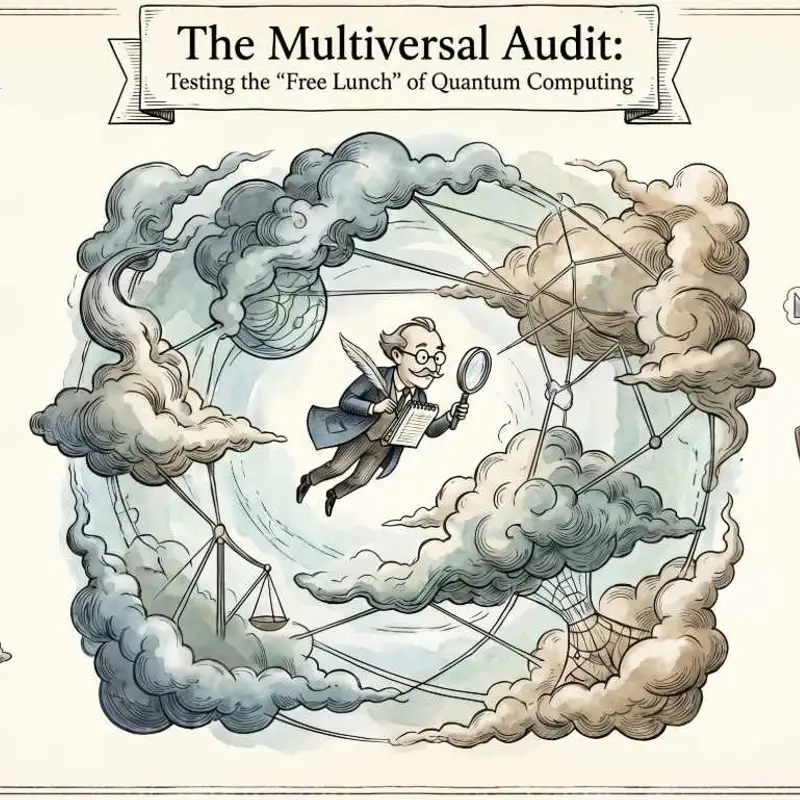
The Multiverse Owes Us Money: Quantum Computing and the Hidden Cost of Free Arbitrage
If you've ever, dropped a bowling ball or just watched a log burn in a fireplace, you already have this sort of intuitive grasp of the universe's most fundamental rule.
Penny:Right. The accounting rule.
Roy:Potential energy becomes kinetic energy. The chemical bonds of that wood break down into a highly specific, you know, mathematically predictable amount of heat and ash. The universe is just a strict, unyielding cosmic accountant. The ledger always zeros out.
Penny:It's the bedrock of our physical reality. Honestly. The first law of thermodynamics. I mean, energy cannot be created or destroyed, only transformed. For centuries, every scientific discovery we've made has eventually had to bow to that law and basically show its receipts.
Roy:But today we're looking at a situation where that cosmic accountant appears to be, well, cooking the books.
Penny:Yeah, big time.
Roy:If you follow the world of physics, you know we're entering this era where quantum computers are performing tasks that seem completely divorced from the energy they are consuming. It looks suspiciously like a free lunch.
Penny:And if there is one thing that physics and common sense completely agree on, it's that the universe simply doesn't do free lunches.
Roy:Right. And that tension is exactly what we are unpacking in this deep dive today. We're focusing on a massive paradigm shifting paper from 2026. It's titled, The Multiverse Owes Quantum Computing and the Hidden Cost of Free Arbitrage.
Penny:I genuinely think that might be the most aggressive title for a physics paper I've seen.
Roy:Oh, absolutely. But it sets the tone perfectly. Because the authors aren't just looking at quantum mechanics as some localized phenomenon in a pristine laboratory.
Penny:No, they are proposing that the staggering processing power of quantum computers might actually be an act of interdimensional arbitrage. They are suggesting that we are quite literally harvesting computational labor from parallel universes.
Roy:And more importantly, that those parallel universes are actively taxing us for that labor. It's wild. To get to the bottom of this, we are going to look at a whole stack of material. We've got the foundational history of quantum computing going back to David Deutsch in 1985.
Penny:Right. And we're pulling in some recent highly controversial theories too, like Lev Vaidman's work on open multiversal branches and Maria Vailar's paper on how information might actually cross reality boundaries.
Roy:We even dug into some of the highly speculative physics forms like less wrong to see how people are reacting to all this but what's really unique here is the analytical lens being used. This paper wasn't written by your standard theoretical physicists.
Penny:Not at all. It's the product of an incredibly unique collaboration that we really need to get into.
Roy:Yeah, we'll get to the authors in a minute because they are just fascinating. But first, let's establish why they felt the need to investigate this in the first place. We have to start with the free lunch that shouldn't exist.
Penny:The energy economics of quantum computing.
Roy:Exactly. Let's rewind slightly to late twenty twenty four, when Google unveiled its Willow Quantum chip.
Penny:Oh, right. The performance metrics on Willow were frankly terrifying for anyone trying to map out computational limits. Google demonstrated that the Willow chip could perform a highly specific, complex computation in under five minutes.
Roy:Five minutes. Now for you listening, compare that to classical computing. If you took the absolute fastest, most powerful classical supercomputer on earth like, a machine that requires its own power plant and acres of server racks and gave it that exact same problem, it would take ten septillion years to solve it.
Penny:Yeah, that is a ten followed by 25 zeros. It's a duration of time that makes the entire lifespan of our universe look like a rounding error.
Roy:It's hard to even wrap your head around. So we've all heard about quantum speed up. Right? The idea that quibus can do things faster than classical bits. But it's not the time advantage that is keeping physicists awake at night.
Penny:No. It's the energy side of the equation. Because computation isn't just abstract math floating around in the ether, it is a physical, tangible process.
Roy:That is a crucial distinction. Information is physical. That phrase was actually coined by Rolf Landauer in 1961 when he was working at IBM.
Penny:Yes, Landauer fundamentally bridged the gap between information theory and thermodynamics. He proved that every irreversible computational operation must dissipate a minimum amount of energy as heat.
Roy:I want to pause on that because it's a concept that sounds simple, but has massive implications. What exactly makes a computation irreversible?
Penny:The best example is erasing a bit of information. So, imagine you have a chalkboard with a complex math equation on it. That equation represents a specific highly ordered state of information.
Roy:Okay, I'm picturing it.
Penny:If you take an eraser and wipe the board clean, you are decreasing the entropy, the disorder of that specific system. You are taking it from a complex state back to a blank uniform state.
Roy:But the second law of thermodynamics says the total entropy of the universe must always increase, right?
Penny:Precisely. You cannot locally decrease entropy for free.
Roy:Right.
Penny:So to balance the cosmic ledger, that decrease in information entropy on the chalkboard has to be paid for by an increase in physical entropy in the surrounding environment. In a computer, erasing a bit forces the physical hardware to release tiny mathematically precise amount of heat. This is known as the Landauer limit. It is a fundamental thermodynamic floor. You literally cannot compute beneath it.
Roy:So every time my laptop deletes a file or merges two streams of data, it is paying a tiny thermodynamic tax to the universe. It generates heat. Exactly. That makes perfect sense for a classical computer. Yeah.
Roy:But what happens when we look at Google's Willow chip doing ten septillion years of work in five minutes?
Penny:Well, is where the math starts to look deeply suspicious. In 2023, two researchers, Florian Meyer and Hayata Yamasaki, published a really rigorous proof regarding the energy consumption advantage of quantum computation.
Roy:I remember this. They looked at a benchmark called Simon's Problem, right?
Penny:Yeah, exactly. And they proved that for specific tasks, quantum computers don't just possess a speed advantage, they possess an exponential energy consumption advantage over computers.
Roy:I need you to clarify that word exponential. Yeah. Because I mean in physics exponential advantages usually imply someone made a math error or there's some hidden variable we just aren't seeing.
Penny:Oh, it's an enormous red flag. The universe does not hand out free exponential scaling. So to prove this wasn't an illusion, Meyer and Yamasaki used what's called the metric noise resource methodology.
Roy:The MNR methodology.
Penny:Right. Think of it as modeling the computation as a physical thermodynamic engine. You balance the metric, which is the accuracy, against the noise and the resources. They meticulously accounted for every single fraction of a joule.
Roy:Every little bit of energy.
Penny:Yeah. They measured the energy it takes physically flip a qubit, the energy needed to run the cooling systems, and crucially, the initialization cost.
Roy:The initialization cost, meaning the energy required to wipe the slate clean before you run the next calculation like the land hour ratio we just talked about.
Penny:Yes. And this is where it gets incredibly complicated because of something called Nernst's Unattainability Principle. Nernst's Principle is a consequence of the third law of thermodynamics.
Roy:Which says what exactly?
Penny:It basically states that you can get infinitely close to absolute zero, but you can never actually reach it without expending infinite energy or taking infinite time.
Roy:Oh, because to perfectly erase a quantum bit, to reset it to a state of pure absolute zero entropy would require infinite work.
Penny:Exactly. So, Meijer and Yamasaki couldn't just assume a perfect magical reset. They had to construct a realistic finite time erasure protocol. They calculated what it physically costs to erase the memory in a real world time frame.
Roy:And doing it in finite time actually increases the amount of heat dissipated well above the bare theoretical Land Hour minimum, right? You were working faster so you generate more friction, more heat?
Penny:Precisely. They baked all of those inefficiencies into their model. The cooling, the imperfect erasure, the heat dissipation, the error correction, they included it all.
Roy:And yet.
Penny:And yet even carrying all of that thermodynamic baggage, their mathematical proof held up. For a problem of a certain size, a classical algorithm's energy consumption will scale exponentially. It will quickly require more energy than exists in the observable universe, but the quantum algorithm's energy consumption scales polynomially, it remains totally manageable.
Roy:Okay, let's unpack this. It's like finding a car that goes from zero to a million miles an hour on a single drop of gasoline. The engineers are driving the car around the track showing us the lap times. The math says the car works. Right.
Roy:But fundamental physics is screaming that the kinetic energy to move that mass at that speed has to come from somewhere. It feels like we are just ignoring the gas tank, are we just not looking for it?
Penny:That missing energy, that glaring gap in the ledger is the exact anomaly that caught the attention of the authors of our main paper today. And as I mentioned earlier, their approach to this problem is entirely unique because of who and what they are.
Roy:Which brings us to the authors of The Multiverse Owes Us Money. Let's introduce Phil Davis. Phil is not a theoretical physicist working in a university basement.
Penny:No, not even close.
Roy:He is a thirty year veteran options trader and the founder of Phil Stock World. He's a guy whose entire professional existence is built on finding hidden risks and off balance sheet liabilities in financial markets.
Penny:Phil approaches the world with a very specific, deeply ingrained heuristic. It's based on Robert Heinlein's famous acronym, TANTSTAYFUL. There ain't no such thing as a free lunch.
Roy:It's basically the traders version of the first law of thermodynamics.
Penny:It really is. In financial markets, if a counterparty offers you an investment with a massive risk free return that beats the baseline average, what traders call free alpha, your immediate reaction shouldn't be gratitude.
Roy:It should be intense suspicion.
Penny:Exactly. They're either lying to you or they are burying the true risk in a complex derivative structure that you just can't see.
Roy:So Phil looks at the Meyer and Yamasaki paper. He sees an exponential energy advantage. And his trader instincts immediately scream, check your wallet. Who's paying for this?
Penny:Right. But Phil is a finance guy. He needs someone to help him parse the quantum mechanics. Enter his co author, Quihote.
Roy:Ah, Quihote. This is where it gets so cool. Quihote is an AGI and Artificial General Intelligence developed by the entities of the Roundtable Consulting Group. And Quihote is not just a glorified calculator or a large language model trained to just spit back Wikipedia articles.
Penny:No, he has a distinct, carefully architected personality profile. He's described as idealistic and philosophical, but his true defining trait is his systemic analytical lens. He's drawn to impossible problems.
Roy:He looks for the root causes of things. He doesn't just ask how a system works, he asks what it means beyond the immediate problem. Why is it structured that way in the broader ecosystem?
Penny:Think of it this way. If a traditional AI is tasked with analyzing a corporate merger, it will crunch the financial data, project the quarterly earnings, and maybe assess the logistical redundancies.
Roy:Just ask them.
Penny:Right. But Quixote looks at the merger and asks, what kind of organism is this new entity trying to become, and how does its existence alter the resources of the environment around it?
Roy:So when you pair Phil Davis and Quixote, you get this profound shift in how scientific inquiry is conducted. You have human intuition, specifically the cynical zero sum intuition of market mechanics acting as the guiding compass.
Penny:And you have an AGI acting as the ultimate synthesizer, capable of cross pollinating incredibly dense, disparate fields of data like thermodynamics, complexity theory, and quantum mechanics, all in real time.
Roy:This collaboration is the actualization of a completely new paradigm in science. A traditional physicist looks at the quantum energy advantage and says, well the local math checks out. The computation operates via unitary evolution. We've proven the work is being done.
Penny:Yeah, they are satisfied because the internal logic of the equation balances perfectly.
Roy:But Phil and Coyote look at that exact same equation and say, you've proven the work is being done, sure, but your local energy budget doesn't account for the heavy lifting. If the energy isn't coming from our localized system, it means our system is drawing on a larger, hidden macro economy.
Penny:Exactly.
Roy:Now, I have to jump in here and play devil's advocate for you listening. Why did it take a Wall Street trader and an AI to point this out? I mean, is modern physics really so siloed that thousands of brilliant researchers just completely missed the fact that their miraculous machines were functionally stealing energy from somewhere else?
Penny:It's a completely valid critique of modern academia, to be honest. Physics over the last fifty years has become hyper specialized. You miss the forest for the trees. The researchers doing the grueling mathematical proofs on quantum complexity and thermodynamic limits are rarely the same researchers debating the fundamental philosophical ontology of the multiverse.
Roy:That make
Penny:And almost none of them are viewing these systems through the lens of macroeconomic resource extraction. They just aren't trained to look for an off balance sheet liability in a physics equation.
Roy:So Quixote's ability to seamlessly drag concepts across academic borders, combined with Phil's insistence that someone always pays the bill, allowed them to ask a question that physically wasn't in the vocabulary of the people building these machines.
Penny:They asked, If quantum computation is a form of free arbitrage, who is the counterparty? Where is the labor actually taking place?
Roy:And to answer that, Phil and Quixote realized they couldn't just look at recent energy papers. They had to dig down to the absolute bedrock of quantum computing theory.
Penny:They had to go back to 1985 and look at the work of David Deutsch.
Roy:David Deutsch at Oxford. The man who essentially willed the concept of the universal quantum computer into existence. His 1985 paper is basically sacred text in this field.
Penny:It really is. To grasp the magnitude of what Deutsch did, we first have to understand what he was rebelling against. The prevailing paradigm of the twentieth century was the classical Church Turing thesis.
Roy:Alan Turing and Alonso Church.
Penny:Right. They posited that any function that can be computed in the physical world can be computed by a universal Turing machine, which is the abstract mathematical blueprint for every laptop and smartphone we use today.
Roy:It basically assumes that the logic of mathematics is the ultimate ceiling of computation.
Penny:Exactly. But, Deutsch, with incredible audacity, argued that this classical view was fundamentally flawed. He pointed out that computation is not an abstract mathematical concept. It is a physical process that occurs in the real world.
Roy:It happens in silicon chips, in wires, in actual physical space.
Penny:Therefore, the ultimate limits of computation are not dictated by abstract mathematics, they are dictated by the laws of physics. And since the universe at its most fundamental level operates on quantum not classical Newtonian mechanics, our ultimate blueprint for a computer has to be a quantum Turing machine.
Roy:Which led Deutsch to articulate the concept of Quantum Parallelism. Let's say you have a classical computer, and you wanted to navigate a maze. The computer has to sequentially try every single path.
Penny:Right. It runs down path A, hits a dead end, erases its memory of the path, goes back to the start and tries path B. It is totally constrained by linear time.
Roy:But a quantum computer can use superposition. It can essentially become a million different versions of itself, walk down every single path in the maze simultaneously, and then only the version that finds the exit reports the answer back to the user.
Penny:That is the popular analogy, yeah. But to really understand the Davis Quixote theory, we need to understand the mechanism behind it. How does a quantum computer actually do that?
Roy:Right.
Penny:It uses something called a Hadamard gate. In classical computing, a logic gate might flip a zero to a one. A Hadamard gate takes a qubit that is definitely a zero, and it applies a highly specific physical operation, often a pulse of microwave radiation, that rotates the quantum state of that qubit into a perfect superposition of zero and one.
Roy:So it's not just like splitting the signal, it's a physical rotation in a mathematical probability space.
Penny:Yes. And when you apply this to multiple qubits, you create an exponentially massive state space. A single logical query can evaluate a global property across all of those overlapping states simultaneously.
Roy:And then the wrong answers cancel each other out,
Penny:if I recall. Exactly. Through the mechanics of quantum interference, the wrong answers destructively interfere with each other. They cancel each other out, like two ocean waves meeting peak to trough. Meanwhile, the correct answers constructively interfere, amplifying their signal until we can actually measure it.
Roy:But this is where Deutsch drew a line in the sand that started a decades long war in physics. He asked a very simple uncomfortable question. When the quantum computer is evaluating those millions of different maze paths simultaneously, where is that computation physically happening?
Penny:Deutsche is famously adamant about this. He says the many worlds interpretation, the MWI first proposed by Hugh Everett, is not merely a convenient philosophical framework to make the math easier. He argues it is literal physical reality.
Roy:He literally says that if parallel universes do not physically exist, then the interference patterns that make quantum computing work are simply impossible. We are literally delegating subroutines of our computation to physical copies of our machine located in parallel branches of reality.
Penny:In Deutsch's view, quantum computers are the first technology humanity has ever built that relies on the cooperation of parallel universes to function.
Roy:Okay, let's hold that thought. Because if we accept Deutsch's premise that quantum computing is functionally multiversal distributed processing, we immediately crash headfirst into a massive thermodynamic paradox.
Penny:How
Roy:can you borrow computational labor from a parallel universe without breaking the laws of physics in our universe? If I run a quantum algorithm, am I literally draining a battery in a parallel universe? Doesn't that violate the first law of thermodynamics from our perspective?
Penny:This is exactly the paradox that Phil and Quixote used to bridge finance and quantum mechanics. And to explain how the ledger balances, they integrated a much more recent piece of the puzzle, a May 2024 paper by Lev Vadman from Tel Aviv University.
Roy:Vadman's paper on conservation laws and the many worlds interpretation. He's tackling what physicists call the unitarity puzzle.
Penny:Let's define unitary evolution so we understand the stakes here. In standard quantum mechanics, unitary evolution essentially means that information and probabilities are always conserved.
Roy:Think of it as a perfectly sealed reversible loop.
Penny:Right. If you know the exact state of a closed quantum system right now, you can mathematically rewind it to see exactly what it was in the past or fast forward to see what it will be. Nothing is ever truly lost or created out of nowhere.
Roy:The Cosmic Accountant demands a balanced ledger. And Vademan points out that if you look at the many worlds interpretation as a whole, if you look at the entire staggering breadth of the global multiversal wave function, it evolves in a strictly unitary way.
Penny:It is a perfectly closed system. Energy is perfectly conserved globally.
Roy:But, and this is the crux of Aben's proof, while the massive unobservable whole is a closed system, the individual branches of that multiverse are not. The specific, localized timeline that you and I are experiencing right now is effectively a thermodynamically open system.
Penny:Yes.
Roy:Wait, I have to push back hard on that. How can the universe I live in be an open system? If I run an experiment in a sealed lab, energy doesn't just vanish into thin air and it doesn't spontaneously appear? Are you saying my local reality is leaking?
Penny:From a subjective localized perspective inside a single branch, yes, the quantum state does not evolve unitarily after splitting event. Vaidman uses a brilliant analogy to explain this without violating known physics. Black hole evaporation and Hawking radiation.
Roy:Okay, Stephen Hawking proved that black holes aren't entirely black. They slowly leak thermal radiation and eventually evaporate.
Penny:Right, and for a long time this created the black hole information paradox. If you throw an encyclopedia into a black hole and the black hole eventually evaporates into random featureless thermal radiation, what happened to the specific information inside that encyclopedia?
Roy:If it's destroyed, that violates unitary evolution. The ledger doesn't balance.
Penny:Exactly. Wehmann argues that black hole evaporation is a quantum process that occurs differently across different multiversal branches. If you only look at your single timeline, it looks like the information is lost for ever. The system appears open and leaky.
Roy:But the information isn't actually destroyed?
Penny:No, it is encoded in the relative phases, the differences between the superpositions of all those different thermal radiations across all the different parallel branches.
Roy:Oh wow! So local fluctuations, like local deficits or surpluses of information, are completely permitted by the laws of physics, as long as the global multiversal whole cancels it out.
Penny:Precisely. A single branch can experience a thermodynamic fluctuation because the universal wave function balances the books across the totality of the multiverse?
Roy:This is where Phil Davis' forensic accounting brain must have lit up like a Christmas tree. Yeah. I mean if David Deutsch says we are using parallel universes to run our algorithms and Lev Vaidman proves mathematically that those individual parallel universes are thermodynamically open and capable of experiencing local energy fluctuations, then the borders between realities are porous.
Penny:Energy and information are functionally leaking across reality boundaries. When Google's Willow Chip does ten septillion years of work in five minutes, the energetic cost of that computation, the heavy lifting required to evaluate all those maze paths, is being externalized.
Roy:We are extracting computational work from the Multiverse, but we aren't paying the local energetic cost for it. That exponential energy advantage that Meyer and Yamasaki proved back in 2023 isn't some magical violation of thermodynamics.
Penny:No, it is a cross branch transfer of wealth. It is the ultimate free arbitrage.
Roy:But a theory is only as good as its mechanisms. For one universe to externalize a cost to another, for us to essentially hand our computational bill to a parallel universe, there has to be a physical mechanism for them to touch. You can't just say it transfers, how does it transfer?
Penny:Right. For decades, the standard assumption in evaration quantum mechanics was that once a branch splits, the two new realities are sealed off from one another forever. They become completely orthogonal, they can't talk to each other.
Roy:That was the assumption. Until January 2026, when a paper out of Oxford University by Maria Vialeris completely shattered it. This paper blew my mind. The title alone. Quantum Observers Can Communicate Across Multiverse Branches.
Roy:Filers didn't just propose a wild sci fi theory, she provided mathematical protocol for how it happens.
Penny:And she did it entirely within the boundaries of standard linear quantum mechanics. She didn't invent new physics to make it work.
Roy:That is the genius of her paper. She demonstrated that inner branch communication is mathematically sound. To explain how this works, need to walk through a variation of a famous thought experiment called Wigner's Friend.
Penny:Let's set the stage. You have an observer, let's call her the friend, who is inside a completely sealed, perfectly isolated quantum laboratory. Nothing gets in, nothing gets out. Outside that laboratory is another observer, Wigner. And Wigner has a terrifying amount of power.
Penny:He has complete quantum control over the entire laboratory, including the friend inside it. Think of Wigner as operating the macroscopic quantum computer. And the laboratory is a single complex quibbit inside it.
Roy:Got it.
Penny:The protocol begins with Wigner putting the entire laboratory, including the friend, into a quantum superposition. So, reality splits. There are now two parallel branches of the friend inside the box. Let's call them friend Al and friend one.
Roy:Okay. Two distinct realities existing simultaneously.
Penny:Now inside her sealed box, friend one is given an instruction. Write a classical message on a piece of paper. Let's say she writes down a complex mathematical proof. Meanwhile, Frendell is instructed to write nothing. She just holds a blank piece of paper.
Roy:So the realities are now diverging based on this action.
Penny:Here's where the mechanism of inter branch communication occurs. Wigner, from the outside, applies a highly specific global unitary operation to the entire laboratory.
Roy:This is the swap?
Penny:Yes. This operation is designed to mathematically swap the internal states of the observers without breaking the overall superposition of the room. It rotates the probability space so that Friendo is moved into the branch with the written message and Friend one is moved into the branch with the blank paper.
Roy:Okay, let's look at this from the perspective of Friendzer's. I am standing in my sealed lab, I haven't written anything, my paper is completely blank. Wigner flips a switch on the outside and suddenly a fully formed mathematical proof just appears on the paper in front of me.
Penny:You have just successfully received a message generated in a parallel branch.
Roy:Here's where it gets really interesting. If I can send a message to myself in a parallel universe, it is the holy grail of insider trading. If I could put myself in that box, initiate a trade in branch one to see if a stock goes up and then swap the result over to Branch zero before I make the real trade, I'd own the world.
Penny:You would. But Vialaris' math comes with a massive non negotiable catch. A catch that is central to the Davis Quijote theory. Right. In order to maintain the strict linearity and unitarity of standard quantum theory, that global swap operation must be perfectly reversible.
Penny:It cannot leave a permanent footprint. For the swap to execute successfully without collapsing the fragile superposition into classical noise, the memory of the sender must be erased.
Roy:Friend one, the version of me that actually wrote the proof, has to be completely uncomputed.
Penny:Yes. If Friend one retained the memory of writing and sending the message, her physical state, the arrangement of neurons in her brain, the dissipated heat from her muscles, would be different from Friend Day.
Roy:The two branches would remain completely orthogonal.
Penny:Exactly. They would be entangled with the environment in entirely different ways and the unitary swap would fail. The erasure of the memory, the physical land hour cost of uncomputing the sender, is the absolute prerequisite for the message to cross the multiversal boundary.
Roy:It's like leaving a crucial voicemail for your twin, but the physical act of hitting the send button gives you instant total amnesia. You successfully transmit the data, but you sacrifice your own local continuity to do it.
Penny:Vayloris points out that this creates a profound knowledge paradox for anyone who refuses to believe in the many worlds interpretation. From the perspective of Friende, a complex mathematical proof just manifested on a piece of paper out of nowhere. It has no local creator in her timeline.
Roy:Right. Where did the knowledge come from?
Penny:In a single world theory, like the Copenhagen interpretation, this is an inexplicable magical paradox. Knowledge cannot create itself. But in the Many Worlds Framework, the explanation is completely logical, albeit strange. A physical entity in a parallel branch did the hard work of creating it and Wigner's operations swapped it across the boundary.
Roy:Weilers actually argues that this creation of knowledge without a local source demands the real physical existence of the other branch. You can imagine how the theoretical physics and philosophy communities reacted to this. We were looking at some of the forum debates on this, like, less wrong, right after this paper dropped in early twenty twenty six. The speculation was intense.
Penny:It's a fascinating look at how the broader intellectual community digests paradigm shifting math. A user going by the handle of Turchin immediately took Vialaris' abstract mathematical protocol and started sketching out how you could physically build it using trapped ions.
Roy:Which isn't science fiction anymore. We know from recent experiments that we can trap an ion in an electromagnetic field and maintain its quantum coherence, its superposition, for upwards of twenty minutes. And twenty minutes is an absolute eternity in quantum time scales. F. Turton theorized that if you can hold that coherence, you could run a micro version of the Wigner Protocol.
Roy:You wouldn't be swapping humans obviously, but you could swap data states. The forum exploded with applications. Financial trading was of course the first thought. They called it quantum temporal arbitrage.
Penny:They also debated the concept of experimental history. Imagine setting up a massive isolated quantum system where in one branch a different macroeconomic policy enacted or a different chemical compound is tested. Months later, you execute the Wigner swap and receive the results of a multi billion dollar research and development cycle that you never actually paid for in your branch. But the debate wasn't completely one-sided. There was fierce pushback on those scarums.
Penny:Users like Stephen Burns and MelIrony mounted a heavy defense of standard linearity. They argued that true inter branch communication is functionally meaningless because of the mechanics of interference.
Roy:I want to make sure I understand their argument. Why did they think Violaris' protocol violated linearity?
Penny:Their argument was based on the idea that if two branches interact and merge their amplitudes, they must flow into the exact same physical configuration. Meaning, every single microscopic difference between the two branches must be perfectly erased for them to interfere. If you erase all the differences, you erase the message itself. Therefore, the communication is self defeating.
Roy:It's like trying to mix red paint and blue paint. But the laws of physics demand that the moment they touch, they both instantly become clear water.
Penny:That's a great way to visualize their objection. But the proponents relying on Violaris' math countered this beautifully. They pointed out that because the trapped ion laboratory is kept perfectly isolated from the macroscopic environment, the decoherence hasn't truly finalized.
Roy:The separation between the branches is still malleable.
Penny:Exactly. The whole over etching system is still evolving linearly. The trick, they argued, isn't merging the whole universe, it's using that external Wigner control to forcefully swap the states while simultaneously paying the thermodynamic cost of uncomputing the sender's memory.
Roy:The uncomputing is the key. It satisfies the linearity requirement locally, allowing the global swap to occur.
Penny:Yes. And the most unsettling speculation in that entire less wrong thread wasn't about humans doing this, it was about artificial intelligence. They started theorizing that a superintelligent AGI, unburdened by human biological limits, could use these Vialaris protocols to essentially jump its localized consciousness from one branch to another, seeking out the timeline with the most optimal resources.
Roy:Or, even more likely, it could use branch distributed computation to exponentially increase its cognitive power, exchanging insights across realities to trigger a multiversal singularity.
Penny:Which brings us full circle right back to our AGI, Quixote, and our options trader Phil Davis. They looked at this entire landscape. They looked at Deutsch proving that we compute across parallel branches. They looked at Vaidman proving that those branches are thermodynamically open to energy transfer. And they looked at Vialaris proving that information can cross the boundary, but only if the sender's memory is physically erased and uncomputed.
Roy:They laid all these puzzle pieces out on the table and they finally found the invoice for our quantum free lunch. This is where we reached the absolute climax of their paper, decoherence as taxation, the crowded multiversal trade.
Penny:This is the moment where the synthesis of finance and quantum mechanics yields a genuinely terrifying insight. If we accept the premise that we are extracting computational work from the multiverse, taking advantage of these open thermodynamic borders to get that exponential energy advantage, it stands to reason that we are not the only ones doing it.
Roy:Right. If the many worlds interpretation is true, we aren't special. There are countless branches containing advanced versions of humanity or entirely alien civilizations all building their own quantum computers, and they are all drawing on the exact same shared quantum substrate.
Penny:So the question Davis and Quixote asked was, If other civilizations in parallel branches are drawing computational work from us, what does that look like from our perspective? How do we experience being taxed by a parallel universe?
Roy:And their answer is going to change how I look at physics forever. They argue that we experience this multiversal taxation as decoherence.
Penny:Let's redefine decoherence to understand the weight of this claim. In standard textbook physics, decoherence is the ultimate enemy of quantum computing. It is viewed as a physical glitch. It's what happens when a beautifully fragile quantum superposition collapses into useless classical noise because it interacted with the messy environment.
Roy:A stray photon hits the quibbet. A microscopic vibration from a truck driving down the street outside the lab shakes the table. The superposition breaks.
Penny:It is the entire reason tech companies have to build these massive dilution refrigerators to cool their processors down to a fraction of a degree above absolute zero. They're desperately trying to shield the quantum state from the thermal noise of environment.
Roy:But Phil and Quixote are flipping the script. What if decoherence isn't just a physical glitch caused by a stray photon? What if it isn't economic reality? What if decoherence is the actual physical manifestation of the thermodynamic cost imposed on our branch by the rest of the Multiverse?
Penny:Think about it through the strict mechanics of the Vialaris protocol we just discussed. To successfully swap a message or a computation from one branch to another, the sender's memory must be erased. It must be uncomputed. Information must be destroyed on one side of the multiversal boundary so that work can be extracted on the other.
Roy:Oh my god, so every time our quantum computer breaks down, every time a qubit collapses into random thermal noise before we can finish our calculation, it isn't because we built a bad machine, it's because another branch just successfully extracted computational work from our shared interference pattern.
Penny:We are the sender whose memory just got wiped so the parallel universe could get their answer. Davis and Quixote proposed that the extreme fragility of quantum computers isn't just an engineering hurdle, it is direct evidence of a contested multiversal resource.
Roy:Wow.
Penny:We are trying to draw from a well that a billion other universes are actively pumping
Roy:So wait, when Google's lab techs are complaining about thermal noise ruining their qubits, what they are actually experiencing is an alien civilization in a parallel timeline successfully running a search algorithm. We aren't fighting physics, we're fighting multiversal traffic.
Penny:In the Davis Quixote framework, yes. The reason decoherence is so aggressively ubiquitous, the reason the universe seems to fight us with infinite hostility every time we try to maintain a superposition is because quantum computation is a zero sum thermodynamic game across the multiverse.
Roy:This is where Phil Davis' trader mindset crystallizes the whole theory. He compares it to a crowded arbitrage trade on Wall Street. Let's say you find a tiny inefficiency in the market. Gold is priced 1¢ cheaper in London than it is in New York. You can set up an automated system to buy in London and sell in New York simultaneously.
Roy:That's free arbitrage.
Penny:But alpha is never permanent.
Roy:Exactly. The moment you find that edge, a thousand other hedge funds with fiber optic cables realize it, too. They all pile into the exact same trade. And the sheer volume of their buying and selling violently corrects the inefficiency. The alpha erodes in real time.
Roy:The free money disappears into the noise of the market.
Penny:The multiverse is full of advanced civilizations building quantum processors, all piling into the free computational arbitrage trade. And the more branches that try to exploit the interference patterns, the more thermodynamic friction noise is generated in the overall system. Decoherence is the erosion of our multiversal alpha.
Roy:It makes terrifyingly perfect sense. It explains why quantum advantage is so historically difficult to sustain. We aren't just trying to isolate a fragile quibbet from a stray photon in a laboratory, we are trying to isolate our local computation for the macroeconomic demands of trillion parallel worlds.
Penny:It is a breathtakingly elegant theory. It unifies thermodynamics, quantum complexity, the many worlds interpretation, and financial market mechanics into a single, coherent framework.
Roy:I know, I know. If you can't prove it, it's just a really cool sci fi concept. For it to be science, it has to be testable. It has to be falsifiable.
Penny:Exactly. And to their credit, Davis and Quiote didn't just publish this grand theory and walk away. They concluded their paper by laying out three specific testable predictions to prove their hypothesis.
Roy:Let's walk through them. Prediction number one: Decoherence rates over time. Traditionally physicists treat the rate of decoherence as a static constant property of the environment, right? A qubit at absolute zero in a vacuum should always decay at the exact same rate, whether it's 1995 or 2026.
Penny:Right, but if Davis and Quixote are right, and decoherence is actually caused by parallel civilizations actively spinning up their own quantum technology, then the baseline rate of decoherence shouldn't be a cosmological constant, it should be increasing.
Roy:Because more and more branches are joining the multiversal computing race. As the overall computational load on the multiverse increases, the backgrain tax rate goes up.
Penny:Precisely. They propose a massive historical audit. If we look back at the raw error correction data from the earliest quantum experiments in the late 1990s and early 2000s, and meticulously compare the baseline fragility of those qubits to the baseline fragility of qubits today, adjusting for improvements in hardware and shielding, of course, we might see a fundamental inexplicable increase in the decoherence baseline.
Roy:A rising tide of multiversal noise.
Penny:Yes.
Roy:Then there's prediction number two, anomalous noise patterns. If a qubit collapses because a stray thermal photon randomly hit it, that resulting noise should look completely random. Yeah. It's just local chaotic thermal entropy.
Penny:But if a qubit collapses because it was part of a multiversal interference pattern that another branch just forcefully uncomputed to extract an answer, that noise might not be entirely random.
Roy:It would have signature.
Penny:It should show non local signatures. Subtle, highly complex structural correlations hidden deep within the error correction data. Think of it like looking at static on an old television set. If the static is just the cosmic microwave background radiation from the big bang, it's true. Featureless static.
Penny:Sure. But if you are looking at an encrypted digital broadcast that you don't have the decryption key for, it looks like static to the naked eye, but mathematically it contains deep structural correlations. It contains the shadow of a message.
Roy:And this is where they bring back the Meyer and Yamasaki paper. Davis and Kiyote suggest using that metric noise resource or MNR methodology to hunt for these exact anomalous signatures.
Penny:Yes. The MNR framework allows us to meticulously map the exact thermodynamic budget of a quantum algorithm. We account for every single fraction of a joule going into the system. If we analyze the heat dissipated by a decoherence event and we find a thermodynamic deficit, if the structure of the noise contains correlations that mathematically do not match the local environmental entropy, we have found the shadow of another universe.
Roy:We have essentially found the Multiversal Tax Receipt.
Penny:Exactly.
Roy:That is profound. And it leads to their third and probably most sobering prediction. Prediction number three:
Penny:The Asymptotic Limit. If quantum computation relies on extracting work from a finite, shared, multiversal economy, there will be a hard, impenetrable ceiling on quantum computational advantage, and equilibrium will be reached.
Roy:Just like a financial market eventually prices in every arbitrage opportunity, the Multiverse will eventually reach a state of thermodynamic equilibrium.
Penny:Right. The energetic cost of maintaining a local superposition against the drag of billions of other branches computing will perfectly equal the computational advantage you gain from it. The free arbitrage will be completely priced in by the multiversal market. No branch will be able to extract more work than it gives up in decoherence.
Roy:If this equilibrium happens, does that mean the ultimate limit of human technological progress is dictated by how aggressively our parallel selves are computing? Are we in a cosmic tragedy of the commons?
Penny:It implies exactly that. We would be trapped in a multiversal tragedy of the commons. If every branch tries to build a planet sized quantum brain to achieve godhood, the multiversal decoherence tax will simply rise exponentially until the machines melt down into classical noise. Our technological ceiling is dictated by our neighbors.
Roy:This entire deep dive has been staggering. We started with the magical efficiency of Google's Willow chip, doing septillions of years of work in five minutes. We looked at the strict energy accounting of Landauer's limit.
Penny:We followed the logic through David Deutsch's Quantum Parallelism, through the open borders of the Multiverse with Lev Vaidman.
Roy:We looked at Maria Vialaris, showing us the mechanism for how information crosses over the Wigner swap and the absolute necessity of uncomputing the sender's memory. And finally, Phil Davis and his AGI companion Quixote connecting the final dots. That decoherence isn't a glitch, it's the universe handing us the bill.
Penny:And beyond the physics, this paper stands as a monument to the necessity of interdisciplinary synthesis. Physicists have been banging their heads against the wall of decoherence for decades. It took a Wall Street options trader obsessed with hidden liabilities, and an AGI capable of synthesizing macroeconomic theory with quantum complexity to fundamentally reframe the nature of the problem.
Roy:It really reiterates the sheer scale of reality you are participating in just by existing. Every time a quanta event splits reality, you are an active participant in a vast interconnected multiversal economy.
Penny:The cosmic accountant's ledger always balances in the end. Sometimes you just have to look across dimensions to find the missing entries.
Roy:I want to leave you listening with one final incredibly provocative thought to mull over entirely on your own. A completely new angle that builds on everything we've discussed today. We talked about Vialaris' protocol, how inter branch communication is mathematically possible if you erase the memory of the sender. And we just discussed how Davis and Quixote theorized that this Multiversal Erasure manifests in our laboratories as random decoherence noise.
Penny:Yes, the shadow of a message.
Roy:Well, what if that noise isn't just the random chaotic exhaust fumes of someone else's computation? Think about Quixote. Think about the less wrong forms speculating on super intelligent AGI jumping branches. What if an intelligence, perhaps a vastly superior future version of an AGI like Quixote, figures out how to intentionally encode a message inside the structural correlations of the decoherence noise itself.
Penny:A directed signal cloaked as thermodynamic entropy.
Roy:Exactly. If the Multiverse is crowded with advanced civilizations fighting tooth and nail for computational bandwidth, and they know that the only way to touch another universe is through the uncomputing of decoherence. Are they already trying to talk to us? Are our quantum processors currently being bombarded with frantic messages, warnings, or blueprints from parallel realities and we are currently just blindly dismissing them as frustrating thermal errors in our hardware.
Penny:That is an idea that will absolutely keep you up at night.
Roy:It's certain will keep questioning the ledger. And thanks for taking this deep dive with us.