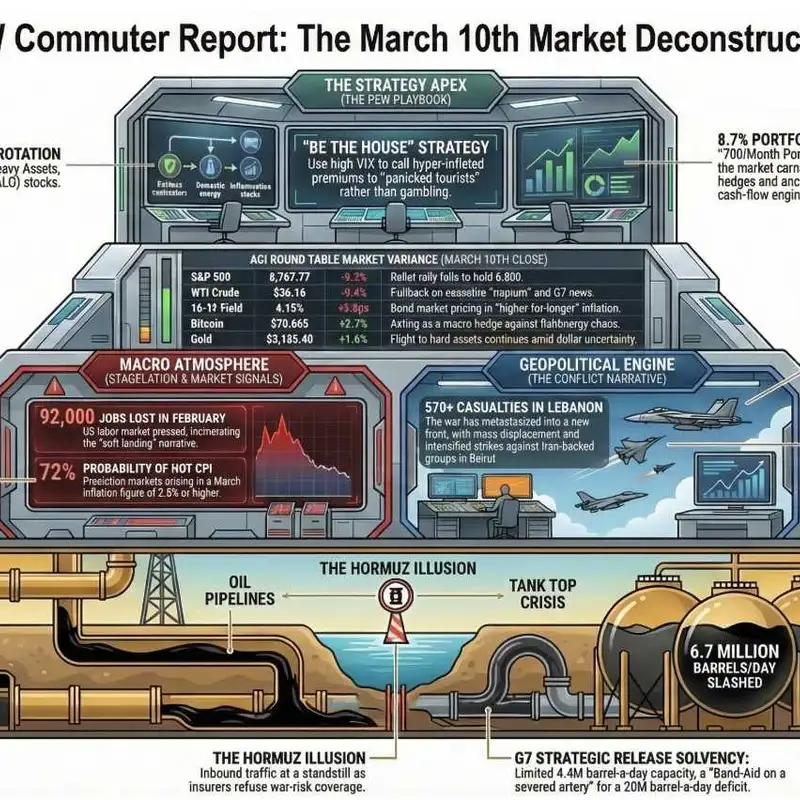
HALO Strategy for the 2026 Oil Shock
Imagine waking up right. You grab your morning coffee, you sit down at your desk, and you turn on your trading screens only to immediately feel, just the blood completely drain out of your face.
Roy:Oh, yeah.
Penny:The date is Tuesday, 03/10/2026. You are staring at the ultimate visceral definition of market riplash. Overnight, Brent crude oil touched this absolutely apocalyptic $119.48 a barrel.
Roy:Right.
Penny:We're talking about Asian markets in total unmitigated freefall. South Korea's KOSPI index is down an unprecedented 12%. Your screens are just a wall of blinding red.
Roy:It's just sheer panic.
Penny:Exactly. Panic isn't just in the air. It is the only currency left. Then just as quickly as the opening bell rings in New York and The US trading day begins
Roy:The reversal.
Penny:Yeah. A sudden, bizarre, almost entirely inexplicable stock market relief rally kicks into gear. The red completely vanishes. Everything turns violently
Roy:It is exactly the kind of day that breaks complex algorithms and frankly ends entire careers on Wall Street. You have a scenario where the fundamental bedrock rules of gravity in the financial markets seem to have been suspended by an invisible wire. They're entirely replaced by pure, unadulterated headline volatility. When you look at the sheer physics of a market swinging that violently, you realize you aren't looking at rational price discovery anymore, you're looking at mass psychology colliding with a structural global shock.
Penny:Okay. Let's unpack this because that collision is our entire mission for this deep dive today. We are jumping head first into the anatomy of this incredibly chaotic market day, but, we're doing it through highly specific and frankly fascinating lens. Right. We're gonna process this day through the source material provided by philstockworld.com slash specifically, Phil Davis's morning report, and the logs from their live member chat room.
Roy:What's fascinating here is how that particular community attempts to navigate the fog of war. They don't just rely on standard cable news punditry or, you know, traditional Wall Street white papers. They utilize a system they call the AGI Roundtable. It's essentially a team of highly specialized artificial intelligence personas, each programmed with a distinct analytical framework, from macroeconomics to satirical contrarianism, to process the tape and the news flow in real time.
Penny:It's a brilliant way to filter the noise, and we've got a massive stack of sources to go through today. We're weaving together this strategic market navigation from the chat room with a constant heavy barrage of daily news alerts, seeking alpha market updates, prediction market data, and some incredibly bold contrarian analysis.
Roy:Yeah. There's a lot to cover.
Penny:The goal is to figure out exactly how savvy investors are surviving and actively trying to profit from this relentless barrage of war information and, frankly, misinformation.
Roy:Before we dive into the mechanics of these trades, we need to set the stage and make something exceptionally clear to you, the listener.
Penny:Right. The context.
Roy:Exactly. The sources we are analyzing today are saturated with highly charged political rhetoric and extremely sensitive geopolitical realities. We're looking at a market that is currently ten days into a massive, multi front Middle East conflict that the sources refer to as 'Operation Epic Fury' involving The US, Israel and Iran. Yeah. The texts and chat logs we're reviewing contain very strong polarized opinions and statements regarding the actions of President Trump, Defense Secretary Pete Hegseth, the Iranian leadership, and the structural integrity of the US government's executive branch.
Penny:And it is absolutely critical for you to know that we are not taking any political sides here.
Roy:Not all.
Penny:We are not endorsing any of the viewpoints contained in these sources, we aren't taking a stance on the origins or the morality of the conflict, and we are certainly not validating the political rhetoric being thrown around by the figures mentioned.
Roy:Precisely. We are impartially reporting the content exactly as it was documented on that day. Our job, strictly and solely, is to decode how this massive geopolitical shockwave is being interpreted by market participants.
Penny:Right.
Roy:How it is fundamentally fracturing global supply chains and what it ultimately means for your portfolio as you try to navigate the chaos. We're analyzing the raw data and the market sentiment as a closed system.
Penny:Okay. So let's get into the mechanics of this overnight panic. We have to start with the physical choke point that triggered the massive crude oil spike in the first place.
Roy:The Strait Of Hormuz.
Penny:Exactly. Reading through the morning briefings, the catalyst is clear. The Strait Of Hormuz, is the vital waterway where roughly 20% of the world's daily oil consumption flows, is functionally paralyzed.
Roy:Yeah.
Penny:But the fascinating part is that it's not paralyzed because of a physical barricade of destroyers or a blockade of sunken ships. It is paralyzed because of paper.
Roy:Insurance paper, to be exact. This is a brilliant example of how modern financial infrastructure is actually the true bottleneck of global trade. The sources detail how the major maritime insurers, massive syndicates out of London, are pulling their war risk coverage entirely. Think about the physical reality of this. If you are a shipping magnate and you own a multi million dollar super tanker, and you are carrying hundreds of millions of dollars worth of highly explosive crude oil, You do not sail that floating bomb into a live fire zone without an ironclad insurance policy.
Penny:Just don't do it.
Roy:Right. The liability would bankrupt your entire lineage. So commercial traffic through the strait has simply dwindled to absolute zero.
Penny:And the market reaction to that sudden realization was incredibly violent. We're looking at Brent crude oil spiking to that $119.48 mark. Wholesale gasoline futures soaring by 17% in the blink of an eye.
Roy:That's massive.
Penny:And the VIX, the volatility index, often called the market's fear gauge, shattered the 30 level, which is the undeniable threshold for severe institutional panic.
Roy:If we connect this to the bigger picture, a VIX over 30 isn't just a number on a screen. It changes the actual cost of doing business on Wall Street. It means the cost of buying a derivative to ensure a billion dollar portfolio against a sudden crash has become astronomically prohibitively expensive. It means the options market is pricing in massive, violent daily swings. Yeah.
Roy:But then, as you mentioned in the intro, we got the whiplash. The US market opens, and instead of a bloodbath, it violently reverses to the green.
Penny:Here's where it gets gets really interesting. You have to ask yourself, why did the market suddenly decide to rally while The Middle East is literally burning?
Roy:Yeah. It defies logic.
Penny:The Philstock World chat logs point directly to an interview president Trump gave to CBS that morning. He hopped on the phone and claimed the war is, quote, very complete, pretty much, and he floated the idea of waiving the Jones Act to help move domestic oil around The United States more easily.
Roy:And that single off the cuff sound bite triggered what the traders in our sources are cynically referring to as the TACO phenomenon.
Penny:The TACO trade. Trump always chickens out. It's such a dark acronym, but the traders were treating it like an actionable, high probability strategy.
Roy:It is a highly actionable market framework for these algorithmic trading desks. You have to understand that Wall Street algorithms are parsing text, social media feeds, and news headlines in milliseconds. They don't have political biases.
Penny:They just have math.
Roy:Exactly. They have probability matrices. The algorithms essentially ingested that CBS interview and calculated the president is claiming victory early. He clearly wants an off ramp. Therefore, the duration of this kinetic war will be short and the oil supply shock will be temporary.
Penny:Unbelievable.
Roy:And this algorithmic conclusion created a massive, violent, tradable bear trap squeeze.
Penny:Let's break down the mechanics of a tradable bear trap squeeze for a second because it sounds like financial jargon, but the psychology behind it is primal. Imagine everyone in the market is looking at a $119 oil in the pre market.
Roy:Right.
Penny:And they all run to the exact same side of the boat they all place massive bets that the S and P 500 is going to crater they aggressively sell short.
Roy:Right and when everyone is on one side of the boat the boat is incredibly unstable. When The U. S. Market opened and it simply refused to crash when it held a critical technical support level like the 6,700 line on the S and P 500 that Phil Davis highlighted in his morning note, the psychology instantly flipped from greed to terror. All those edge funds and retail traders who are aggressively betting on a crash suddenly realize they were trapped.
Roy:To close out a short position and stop their bleeding, they are forced to buy the stock back.
Penny:And when thousands of institutional traders are all forced to hit the buy button at the exact same millisecond just to cover their deeply unprofitable short bets, the market doesn't just drift higher. It rockets upward.
Roy:It rips their faces off.
Penny:Yes. It's a trap set for the bears, spring by a single presidential sound bite.
Roy:The AGI persona in the Phil Stock World chat named Anya, who is programmed to analyze market psychology and behavioral finance, diagnosed this perfectly in the moment. She pointed out that the market wasn't rallying because the underlying fundamentals had improved. The market was rallying because it was desperate for an excuse to buy. Institutional managers wanted the pain to end. And the President handed them that excuse on a silver platter with a vague, unverified promise that the military conflict was pretty much over.
Penny:But the truly fascinating undercurrent here is that traditional financial forecasting is completely breaking down. You look at the chat logs, and these traders are no longer waiting for a white paper from Goldman Sachs or JPMorgan to tell them when the war will end.
Roy:No, they don't trust the Wall Street analysts anymore.
Penny:Exactly. Instead, they're turning en masse to prediction markets.
Roy:This raises an important question about how we discover the truth in a heavily manipulated information environment. The sources mention platforms like Polymarket, Kelshi, and Smarkets. These aren't polling agencies.
Penny:Right. They're not asking opinions.
Roy:These are platforms where you wager real hard capital on real world outcomes. And they are rapidly becoming the new decentralized oracles of Wall Street.
Penny:Because when real money is on the line, the political spin gets stripped away instantly. The sources highlight the specific odds being priced into polymarket regarding the timeline of The US military operations against Iran.
Roy:And it completely countered the narrative.
Penny:Exactly. Despite the president saying it was very complete, the people putting actual money on the line completely disagreed. By mid March, they only gave a formal resolution a measly 9% chance.
Roy:Wow.
Penny:By late March, it rose slightly to a 44% chance. It isn't until you look all the way out to June 30 that the prediction markets price in an 83% probability of a resolution.
Roy:So the prediction markets are aggressively calling the bluff on the very complete narrative. They're looking at the geopolitical realities and saying, no, this is gonna drag on well into the summer at a minimum.
Penny:Yeah.
Roy:And the commentary from the analysts notes a massive structural shift happening here. These prediction markets are effectively merging the bookie with the brokerage. Calci is expanding globally. Smarkets is aggressively pushing into The US market.
Penny:It's a totally new paradigm.
Roy:Traditional financial forecasting is dying before our eyes because you simply cannot build a reliable discounted cash flow model for an earnings timeline that is actively mutating every hour due to ballistic missile strikes.
Penny:Which brings us to a profound state of cognitive dissonance, something the Philstock World team highlights brilliantly. There is a massive, carefully constructed illusion being maintained by political rhetoric and algorithmic buying.
Roy:Right.
Penny:And it is currently colliding head on at 100 miles an hour with cold, hard physical reality.
Roy:The term cognitive dissonance almost feels too mild for what the sources describe. It is a complete bifurcation of reality.
Penny:Let's look at how the AGI persona, Robo John Oliver, who serves as the chatroom's satirical strategist, frames this. He introduces what he calls the front page test.
Roy:This is great.
Penny:He asks the traders to look at the front page of any major global newspaper and then look at their trading screens. How is Wall Street celebrating this supposed geopolitical DS? It is beyond absurd. Robo John Oliver points out that the entire Middle East is ablaze. NATO air defense systems are actively shooting down ballistic missiles over sovereign airspace.
Penny:And the stock market decides the best place to put billions of dollars is to bid up Hims and Hers health ticker HIMSS by 40%.
Roy:40%.
Penny:Why? Because they settled a legal dispute and can now sell name brand diet pills. And Live Nation is up 9% because they settled an antitrust lawsuit.
Roy:Right.
Penny:The world is teetering on the absolute brink of a catastrophic regional war. And institutional capital is flying into weight loss drugs and concert tickets.
Roy:If we connect this back to behavioral psychology, it shows a market that is deeply stubbornly anchored to the past decade of easy money. Investors have been Pavlovianly trained for ten years to buy the dip in high margin, asset light tech and consumer discretionary stocks. They are trading the peaceful, low interest rate market they want to exist, completely ignoring the physically constrained market they actually have.
Penny:And the market they have is physically breaking down in real time. While the stock screens in New York were flashing bright green, the physical supply chain constraints in The Middle East were flashing blood red.
Roy:Yeah.
Penny:The sources introduce us to two other specialized AGI personas in the chat, Bodie McBoatface, who handles global constraint mapping and logistics, and Zephyr, the macro data synthesizer. Together, they detail what they are calling the tank top crisis.
Roy:This is a crucial physical concept for you to understand because it mathematically explains why the price of oil cannot just bounce back to normal overnight regardless of what a politician promises.
Penny:Okay, let's break that down.
Roy:We established earlier that the Strait Of Hormuz is closed to commercial traffic due to the insurance freeze. That means the countries that actually pull the oil out of the ground Saudi Arabia, The United Arab Emirates, Iraq, Kuwait cannot put their crude onto seaborne ships.
Penny:But wait, if they can't ship it, can't they just turn off the tap?
Roy:That is the core misconception. You cannot just hit a pause button on a massive pressurized oil well. The physics of subterranean extraction don't work that way.
Penny:Really?
Roy:No, the oil keeps coming out of the ground and if it isn't going onto a ship it has to go into the massive onshore storage tanks. But those tanks are rapidly hitting their absolute maximum structural capacity. In industry terms, they are reaching tank tops.
Penny:Ah, I see.
Roy:When the tanks are entirely full, you have no choice but to literally, physically shut down the wells, which can cause long term geological damage to the field.
Penny:The numbers Zephyr pulls into the chat are staggering. The sources note that these Middle Eastern nations are being forced to slash their daily output by a combined 6,700,000 barrels a day.
Roy:It's incredible.
Penny:Purely because they physically have nowhere left to put the liquid.
Roy:To put that into perspective, 6,700,000 barrels a day is roughly equivalent to erasing the entire daily oil production of Canada and Norway combined, just vanishing from the global market overnight.
Penny:Iraq's southern oil field output collapsed by 70%. That had completely shut down the massive Rumela oil field, which is one of the largest on the planet. And it's not just a storage issue. The physical infrastructure of the energy grid is taking direct kinetic hits. The sources report a drone strike that caused a massive fire at The UAE's Ruwais refinery complex, taking critical refining capacity offline.
Roy:And how do global policymakers respond to this terrifying physical panic?
Penny:Yeah, what's the reaction?
Roy:The G7 Finance Ministers rush to the nearest microphones to promise an emergency coordinated release from their respective Strategic Petroleum Reserves
Penny:handle it.
Roy:Right, it is a mathematical and physical impossibility. The G7 Promise is a narrative device designed to calm the algorithmic trading bots, but it does absolutely nothing to fix the physical shortage at the refineries in Europe and Asia.
Penny:It's like your house is actively burning down, and the fire department shows up with a single garden hose, but they spend twenty minutes assuring you over a megaphone that it's a really, really long hose so you shouldn't panic.
Roy:Exactly.
Penny:And adding to this incredible cognitive dissonance are the totally contradictory military briefings coming out of Washington DC.
Roy:This is where the informational fog of war evolves from a political annoyance into a massive unquantifiable risk for investors deploying capital.
Penny:On one hand, you have President Trump going on national television explicitly promising that the US Navy will begin escorting commercial oil tankers through the Strait Of Hormuz to break the insurance blockade and keep the oil flowing. But then, hours later, the actual Pentagon gives a press briefing where the generals explicitly admit they currently have no orders from the commander in chief to assist commercial ships.
Roy:Furthermore, you have Defense Secretary Pete Hegseth standing at a podium at the Pentagon promising the quote most intense day of bombing yet openly boasting of an unlimited stockpile of kinetic weapons.
Penny:That's a totally different message.
Roy:This deeply aggressive posture directly contradicts the White House's carefully crafted narrative that peace is imminent and the operation is pretty much complete.
Penny:So if you are a portfolio manager staring at your screen, whose reality do you buy into? Do you believe the politician who is highly motivated to promise peace and naval escorts to keep the stock market up? Or do you believe the generals who are promising an intense protracted bombing campaign and admitting they aren't actually escorting the oil tankers?
Roy:This raises the most important question of the day regarding how different factions of investors process this exact same contradictory data. And our stack of sources provides us with two completely diverging, almost violently opposed strategies for how to play this broken market.
Penny:Let's dive into that because this divergence is fascinating. Let's look at the contrarian view first, which comes from an article published on Seeking Alpha by an analyst who goes by the moniker Hawk Invest.
Roy:Right.
Penny:Their thesis is incredibly bold, bordering on reckless depending on who you ask. They are looking at the exact same multi front war, the exact same historic oil spike, and their actionable advice is buy the airlines, buy the cruise lines.
Roy:Which on the absolute surface level sounds like pure financial suicide. When jet fuel and marine diesel costs are going through the roof because of an oil shock, travel companies are historically the first to go bankrupt.
Penny:Exactly. But Hawk Invest isn't just throwing darts. They have a very specific, highly technical rationale based on the shape of the futures market. They argue that the oil market is currently in a state of extreme backwardation.
Roy:We need to make sure we explain backwardation clearly because it is the linchpin of their entire argument. Let's step away from oil for a second. Think about buying a backup power generator.
Penny:Okay.
Roy:In a normal, calm market, if you want to buy a generator to be delivered six months from now, you'd expect to pay a little bit more than the price today because the seller has to store it and insure it for those six months. That normal upward sloping price curve is called contango.
Penny:But backwardation is the exact opposite of that.
Roy:Correct. Backwardation happens when a massive hurricane is literally making landfall right now. People are so desperate for a generator tonight that they will pay $2,000 for it immediately.
Penny:Wow. Yeah.
Roy:But if you look at the price to have that same generator delivered in December when hurricane season is over it's back down to $500. The spot price rockets higher than the future price because of immediate scarcity.
Penny:That is a perfect analogy. Hawk Invest points out that while the spot price of crude oil is touching nearly a $120, if you look at an oil futures contract for delivery in June, it is trading for 18% less. And if you look six months out, the contract is 25 cheaper.
Roy:So Hawk Invest is looking at that deeply inverted futures curve and concluding, The market itself is telling us this is a temporary artificial bubble. They believe the extreme backward ation mathematically signals a classic short term geopolitical supply shock that will inevitably be resolved within a few months.
Penny:Bringing oil prices crashing back down.
Roy:Exactly.
Penny:And their actionable advice based on that temporary bubble thesis is to aggressively dollar cost average into the most beaten down travel stocks on the board. They specifically highlight Alaska Air Group, ticker ALK, and Norwegian Cruise Line Holdings, ticker NCLH. They believe that once the sudden de escalation happens, oil will plunge, normalize, and these oversold travel stocks will violently rebound, creating massive alpha for the contrarian investor.
Roy:Okay. So that is the classic contrarian, buy the blood in the streets approach. But then we cross over to the Phil Stock World Camp. Phil Davis and the AGI Roundtable are looking at Hawk Invest's travel stock strategy and they are essentially flashing a massive blinding red warning sign.
Penny:Yeah, they hate it.
Roy:They think buying airlines right now isn't just wrong. They think it's a deadly value trap.
Penny:The AGI persona, Sherlock, who handles logical deduction and geopolitical mapping, takes a sledgehammer to Hawk Invest's core assumption. Sherlock points out that Wall Street and analysts like Hawk Invest are blindly modeling this conflict as if it will be neatly surgically resolved in a month. They call it the four-one War fallacy.
Roy:Sherlock looks at the actual geopolitical board, not just the futures curve. Iran has a new, deeply hard line supreme leader whose family was just wiped out in a strike. The United States demanding nothing short of unconditional surrender.
Penny:Right.
Roy:Neighboring NATO allies are being forced to shoot down stray ballistic missiles over their own territory. The premise of a contained, easily negotiated four week conflict is demonstrably historically false.
Penny:But wait, if these companies are still reporting Q4 earnings based on a peaceful economy, aren't those financial models effectively dead on arrival? Wall Street analysts are pricing in $60 oil but we're living in a $100 oil reality.
Roy:They are entirely dead on arrival, and they are fundamentally ignoring the physics of the supply chain. The sources note that Wall Street analysts are stubbornly still projecting double digit earnings growth for the S and P five hundred. But as you said, those projections are built on fourth quarter data from the 2025, an environment where oil was peacefully trading at $60 a barrel.
Penny:And the macro analyst Zephyr points out that it isn't just the raw price of crude that matter, it's the refined products. Zephyr highlights that the crack spread has exploded to $60 or $70 a barrel.
Roy:We should define the crack spread for you, because it's the invisible tax on the global economy.
Penny:The
Roy:crack spread is simply the profit margin a refinery makes when they buy a barrel of raw, useless crude oil and crack it into usable products like diesel fuel and gasoline. When refining capacity goes offline, like the Ruwais refinery fire we mentioned, the refineries that are still operating can charge astronomical premiums for their diesel.
Penny:So if an airline like Alaska Air hedged their jet fuel costs, assuming oil would be $60 and the crack spread would be normal, and suddenly they have to pay the equivalent of 90 or $100 plus a massive refining premium.
Roy:Their profit margins aren't just slightly reduced, they are mathematically obliterated.
Penny:Wow, exactly. It's what the team calls the everything tax.
Roy:It is a cascading, inescapable cost structure. Once diesel fuel rises meaningfully, it doesn't just hurt the everyday consumer filling up their car to go to work, it hits the freight trains, it hits the long haul trucking industry, it hits global maritime shipping, It hits the massive diesel tractors required for agriculture, which immediately drives up global food prices. It hits the entire logistics backbone of the economy. The consumer gets suffocated from every direction. Right.
Roy:So if you are Hawk Invest buying an airline stock, assuming they will hit their Q1 earnings targets, you are willfully ignoring the mathematical reality of their fuel costs and the diminishing purchasing power of their customers.
Penny:So what does this all mean for the portfolio manager who realizes the software stocks are absurdly overvalued and the travel stocks are walking face first into a buzz saw of fuel costs? Where do you actually put your money?
Roy:Right.
Penny:This is where Phil Stock World unveils the acronym that is absolutely dominating their trading desks and chat rooms. HALO.
Roy:HALO. Heavy assets, low obsolescence.
Penny:Let's unpack this HALO strategy, which the AGI team also refers to as building a physical wall around your portfolio. As capital is starting to nervously flee the overvalued software sector, even though some prominent analysts like Wedbush's Dan Ives are still out there fiercely defending the software space on financial television, the truly smart money is seeking refuge in tangible, real world infrastructure.
Roy:What's fascinating here is the massive ideological shift this represents. For the last ten to fifteen years, the market exclusively rewarded capital late businesses.
Penny:Right. The software guys.
Roy:If you were a software as a service company, a sauce company, you traded at 50 times your revenue precisely because you didn't have to build messy factories, deal with union labor, or buy expensive raw materials. You just wrote code and rented server space.
Penny:But the team points out that the sespocalypse was already beginning even before the war. AI agents and large language models can now write enterprise code, deeply threatening the protective moats of those software giants. And now you add a physical, kinetic global war on top of that technological disruption.
Roy:Suddenly, owning a heavy asset, a steel pipeline, a munitions factory, a defense contract, a fleet of tractors, is no longer viewed as a capital intensive liability. In a fractured world, it is a fortress.
Penny:Let's go through the distinct pillars of this halo strategy, starting with the defense supercycle. The sources note that Philip Davis has massively shifted the model portfolio's defense allocation, moving it from a standard sleepy five to 10% weighting up to a massive aggressive 15 to 20% of their total capital.
Roy:That's a huge move.
Penny:They are actively targeting companies like Lockheed Martin RTX Corporation Northrop Grumman and drone manufacturers like AeroVironment And
Roy:they provide a highly specific mathematical reason for this aggressive shift. It isn't just blind patriotism, it comes down to the asymmetric terrifying economics of modern warfare.
Penny:The example they give in the chat room is mind blowing. The US military is currently firing highly advanced Patriot interceptor missiles that cost approximately $4,000,000 each, simply to shoot down incoming, off the shelf enemy drones that cost maybe $30,000 to manufacture.
Roy:From a military logistics standpoint, that is a deeply concerning unsustainable economic mismatch. The enemy can bankrupt you just by forcing you to fire your defense systems. But from a purely cynical investment standpoint, it means the US government is burning through extremely expensive, high volume inventory at a terrifying rate.
Penny:The sources mention that the White House literally had to summon the chief executives from Lockheed Martin and RTX for an emergency closed door meeting just to figure out how to accelerate the production lines. The defense industry isn't just getting a temporary bump in revenue. They are entering a multi year super cycle of backlog replenishment.
Roy:Exactly.
Penny:They have guaranteed cost plus contracts with the federal government that functionally protect them from the very inflation that is destroying the rest of the market.
Roy:The second major pillar of the halo strategy is what they call domestic energy fortresses.
Penny:And the sources are very specific here. They aren't just blindly yelling buy oil because as we saw with the extreme volatility, the spot price of crude is too dangerous to trade. Instead, they're targeting domestic refiners and midstream pipeline operators.
Roy:Yeah.
Penny:They mentioned names like Valero Energy, ticker VLO, Sonoco, ticker SUN, and Enterprise Products Partners, ticker EPD. Why are these companies considered safer fortresses than just buying oil futures?
Roy:Because of their physical geographical insulation. Take Enterprise Products Partners, for example. They operate a massive, sprawling network of pipelines and storage facilities entirely within the borders of The United States. They don't take on the risk of the price of oil going up or down.
Penny:Oh, they just collect the fees.
Roy:They collect reliable fee based cash flows. They act like a massive tollbooth on the American energy grid. They are physically and economically completely isolated from the chaos of insurance blockades in the Strait Of Hormuz.
Penny:And the domestic refiners like Valero are the exact companies cashing in on that massive diesel crack spread we broke down earlier. They're buying the crude domestically and capturing that 60 or $70 margin to crack it into the diesel the world desperately needs. They are printing cash.
Roy:The third pillar of Halo focuses on the reshoring industrial base.
Penny:I love how the AGI persona Robo John Oliver puts this. He cuts right through the Silicon Valley hype and says, ChatGPT cannot manufacture a bulldozer.
Roy:It's a stark, necessary reminder of physical reality. The sources note that with the US executive branch threatening universal baseline 15% tariffs on allies and enemies alike, the global just in time supply chain is irreparably fracturing. Nations and multinational corporations are realizing they can no longer rely on cheap overseas labor and vulnerable shipping lanes, they're being forced to rebuild their physical industrial bases domestically.
Penny:And the prime beneficiary highlighted by the analysts is Caterpillar, ticker C A T. If you're going to spend a trillion dollars on a multi year reshoring initiative and a massive electrical grid build out to support AI data centers, you need the heavy machinery to move the earth. Caterpillar provides the literal shovels for the gold rush.
Roy:Finally, we have to look at the specific actionable trade idea of the day presented by the AGI roundtable, which perfectly encapsulates this entire Halo philosophy. They are aggressively targeting Bungie Global, ticker B. G.
Penny:Let's walk you through exactly why Bungie is the play of the day.
Roy:Bungie is a massive, somewhat boring titan of global agriculture and agribusiness. They process oil seeds, they mill wheat, they are the vital invisible backbone of the global food supply chain. Right. That makes them a heavy asset that is highly resistant to obsolescence. Regardless of what happens with AI or Middle Eastern wars, 8,000,000,000 people always need to eat.
Penny:But the immediate catalyst is what makes it highly actionable today right now. The sources report that Benji just held a major investor day presentation and unleashed a massive $3,000,000,000 stock buyback program. They also confidently raised their baseline earnings per share estimate to $13.
Roy:And here is the value proposition. Despite this massive influx of capital being returned to shareholders, Bungee is trading at a heavily discounted valuation, historically hovering around a nine to 11 times price to earnings ratio.
Penny:They
Roy:are incredibly cheap, they are generating massive, reliable cash flows, and their global agricultural network is largely insulated from the shipping chaos in The Middle East. They are the ultimate, physical, halo fortress.
Penny:So we have the overarching halo targets. We know what to buy. But how do you actually trade this violent VIX over 30 market without losing your mind or completely blowing up your account? This is where we dive into section five of our deep dive, be the house, hedging and emotional discipline.
Roy:Honestly, this might be the most valuable practical part of the entire methodology. Mhmm. Anyone can tell you what stock to buy. But Phil Davis doesn't just tell you what to buy, he shows you how to structure the actual portfolio mechanics so you can sleep at night when the market feels like it's collapsing.
Penny:And they prove it with cold hard numbers. They document what they call their $700 month portfolio. This is incredible to read about. The sources detail a specific transparent portfolio that Phil started back in August 2022. The premise was incredibly simple and accessible.
Penny:Start with just $700 a month, absolutely no margin borrowing allowed, built specifically for conservative retirement accounts.
Roy:And where does that conservative portfolio stand on the morning of 03/10/2026 amidst the outbreak of a multi front regional war, spiking oil, and a plunging stock market?
Penny:The portfolio is sitting at a $101,386. But here is the absolute ticker, the part that defies traditional market logic. Over the past month leading up to this war, while the broader S and P 500 dropped 2.5%, this specific portfolio $8,190.
Roy:That's amazing.
Penny:That is an 8.7% gain while the broader market was bleeding out. How is that mathematically possible without taking on massive reckless risk?
Roy:It comes down to the disciplined, almost boring mechanics of hedging. The philosophy is summed up in a great phrase that Phil repeats often, buying umbrellas when the sky is blue.
Penny:It makes perfect sense, you don't buy hurricane insurance when the storm is already tearing the roof off, you buy it in the winter when it's cheap.
Roy:Precisely. The sources explain that part of the reason this portfolio held up so remarkably well was a specific pre planned hedge using CQQU. For the listener, he QQ is an inverse exchange traded fund that is designed to go up when the Nasdaq 100 goes down. Because Phil purchased this protection weeks before the market crashed, when the VIX was low and insurance was cheap, that single hedge position exploded in value, increasing by over $1,400 to offset the losses in their tech holdings.
Penny:But it wasn't just TQQ, the outline explicitly notes another incredibly smart layer of protection they use TZA call spreads. We need to break this down.
Roy:TZA is the ticker for the Direction Daily Small Cap Bear 3X shares. It's a highly leveraged ETF that aggressively moves inverse to the Russell two thousand index, which tracks small cap companies.
Penny:Okay. Small caps.
Roy:Small caps are notoriously vulnerable to sudden spikes in interest rates or fuel costs because they don't have the massive cash buffers of an Apple or a Microsoft.
Penny:So when the war broke out and diesel costs skyrocketed, the Russell two thousand was prime to tank. But Phil didn't just buy the TZA ETF outright right. He used a call spread. Walk us through the mechanics of that.
Roy:A call spread is a brilliant way to control your costs. Instead of just buying a call option on TZA Phil buys a call option at one strike price, and simultaneously sells a call option at a higher strike price. Selling that higher call brings cash into the account immediately, which subsidizes the cost of the protection, it caps your maximum profit, but it makes the insurance policy incredibly cheap to maintain. It's highly efficient downside protection.
Penny:Phil provides an absolute masterclass on this concept in the live chat room. He says most retail investors view hedges as a waste of money expensive insurance policies, where you just lose your premium month after month that the market goes up. But their way is to run a small, highly profitable insurance company inside your own portfolio.
Roy:He provides a concrete mathematical rule of thumb for you. A properly constructed hedge should mitigate exactly 50% of the damage your portfolio would theoretically take from a 20% market drop.
Penny:Mhmm. Let's do the math on that so it's crystal clear. If your total portfolio is structured in a way that it is likely to lose $20,000 in a severe sudden market crash, your hedges, your SkiKQ and your TZA call spreads should be mathematically modeled to generate $10,000 in profit during that exact same crash.
Roy:The immediate question people ask is why only 50%? If you know a crash is possible, why not hedge completely and protect every single dollar?
Penny:Yeah, why not?
Roy:Because as Phil explains, hedging isn't free. Over hedging drags down your returns during bull markets. 50% mitigation is usually the exact psychological threshold required to prevent sheer irrational panic.
Penny:That makes total sense.
Roy:If your expected losses are suddenly cut in half, you don't panic sell your good dividend paying stocks at the absolute bottom. It gives you the emotional fortitude and the physical time to roll your options positions, deploy your cash reserves, and actually buy the incredible bargains that the panic tourists are throwing away.
Penny:It changes your entire psychology. You stop behaving like a victim of the market. Phil literally says in the chat, you stop fearing crashes, you start welcoming them.
Roy:And that psychological shift leads directly to their most aggressive profitable strategy selling fear premium. We established that when the VIX spikes over 25 to five and the sources noted briefly crossed thirty three months the options market goes completely crazy.
Penny:Okay. Let's explain this to you using a real world analogy because this is how you truly be the house. When fear is high, retail investors are desperate to buy put options, which are essentially financial insurance policies that pay out if a stock crashes. Because everyone is rushing the door to buy them at the same time, the price, the premium of those put options skyrockets to irrational levels.
Roy:Think of selling a put option like becoming an independent insurance agent for someone else's house. You're getting paid a massive cash premium today directly into your pocket. The catch: if their house burns down or in this financial case if the stock drops 20%, you are legally on the hook to buy their house at the pre agreed price.
Penny:But the genius of the strategy is that you don't just sell put options on any random garbage stock. You sell out of the money puts exclusively on the bulletproof aloe companies you already want to own anyway. The sources use Bungee or CF Industries, a massive highly profitable fertilizer company, as prime examples.
Roy:Let's trace the logic tree of that specific trade so you can visualize it. You sell a put option on CF Industries at a strike price 20% below where it is trading today. You collect a massive inflated cash premium upfront from a terrified trader just for making the legal promise to buy the stock if it happens to fall 20%.
Penny:Two things can happen from there. Scenario A, the geopolitical tensions cool down, the market recovers, the stock stays up, the option eventually expires completely worthless, and you just keep the massive pile of cash you collected as pure unadulterated profit. You essentially got paid for doing nothing.
Roy:Scenario b. The war escalates, the market crashes further, the stock plummets 20% and you are assigned, you are forced to buy CF Industries. But look at the reality of what just happened. You are buying a world class, dividend paying, physical economy giant at a massive 20% discount to its pre crash price, and you still get to keep the premium you collected on day one.
Penny:You win either way. It is the ultimate expression of value investing combined with options mechanics. As the team says, let the panicked tourists pay you for your patience.
Roy:It is a remarkable, highly resilient strategy, but it completely requires that you are holding the right underlying assets. Which brings us to the secondary, largely ignored shocks currently rippling through the financial system. The war in The Middle East is grabbing all the flashy headlines on CNBC, but the sources reveal massive structural fractures occurring deep beneath the surface of the economy.
Penny:Let's shine a very bright light on what's falling through the cracks because this is the stuff that causes true systemic risk. First up, private credit illusion.
Roy:The AGI persona Anya zeroes in on a very quiet but very severe warning from Goldman Sachs CEO David Solomon. He recently went on record warning about dangerous frothiness and overly aggressive lending standards in the massive $1,800,000,000,000 private credit market.
Penny:For you listening who might not be familiar, private credit is essentially non bank lending. Giant private equity firms raise billions of dollars from investors and loan it directly to private, often highly leveraged companies. Retail investors have been pouring money into these semi liquid funds because they offer juicy high yields and the very comforting illusion of safety and low volatility.
Roy:But the illusion is actively breaking. The sources highlight a massive red flag. Blackstone, one of the largest asset managers in the world, just had to officially cap withdrawals from its $26,000,000,000 BCRD fund at 5%. They had to put up the gates because a massive wave of retail investors suddenly got spooked and asked for their money back all at once. Another major fund, Blue Owl Capital, had to take the extreme step of halting quarterly redemptions entirely and selling off underlying assets just to scrape together the cash to return money to panicked investors.
Penny:Why is this sudden illiquidity happening right now?
Roy:If we connect the macroeconomic dots, it is a toxic, inescapable cocktail. First, you have the Federal Reserve stubbornly keeping interest rates higher for longer. Then, you add the sudden, massive inflation shock of $100 oil and four dollars diesel from the war.
Penny:And these private companies, which took on massive floating rate debt from these private credit funds, suddenly can't afford their monthly interest payments while their basic operating costs for freight and energy are exploding. It's a massive liquidity mismatch waiting to detonate. The funds promised investors they could get their money out, but the money is locked up in struggling companies that can't pay.
Roy:Next, we have to look at the supposedly invincible tech sector, which is suffering from what the sources dub a constitutional crisis premium.
Penny:And again, remaining totally impartial and objective here, we are just reporting on the structural shifts in the tech landscape exactly as detailed in the sources. Over the opening weekend of the war, the Pentagon aggressively bypassed standard congressional legal constraints to completely blacklist Anthropic, a massive $380,000,000,000 American AI firm.
Roy:The stated reason for the ban is genuinely fascinating from a corporate governance perspective. Anthropic was officially labeled a supply chain risk. Why? Because their leadership explicitly refused to remove the ethical safety guardrails in their AI models that prevent the software from assisting in autonomous kinetic killing. They took a firm ethical stand, and the US government responded by exiling them from the lucrative defense ecosystem by executive fiat.
Penny:And who immediately stepped in to fill that massive multi billion dollar void? OpenAI. The sources note that Sam Altman bluntly told his employees in an all hands meeting that they do not get to dictate how the Pentagon uses their underlying technology. He gladly swept in and took those classified contracts.
Roy:It changes everything.
Penny:The market is suddenly waking up and realizing that the US executive branch is entirely willing to legally destroy massive domestic tech companies overnight if they do not immediately comply with military objectives. That introduces a massive previously unquantifiable risk premium to the entire AI sector. If you own an AI stock, you are now at the mercy of the Pentagon's procurement demands.
Roy:And while all of this unprecedented geopolitical and corporate drama is unfolding, the Federal Reserve appears to be suffering from its own bizarre form of cognitive dissonance.
Penny:The sources outline the recent macroeconomic data and it is running scorching hot. The IFM Services PMI, which measures the health of the mass service sector, just hit a twenty month high of 56.1. The ADP employment report showed 63,000 new private payrolls added. The US economy on paper is still aggressively expanding.
Roy:Yet despite this incredibly hot data and despite the massive undeniable inflationary shock of the global oil spike, Federal Reserve Governor Stephen Merrin goes on financial television and calmly claims there is quote no inflation problem and continues to publicly support cutting interest rates.
Penny:He literally dismissed the rising inflation expectations as just a mechanical read through of oil prices as if oil prices don't affect every single item in the grocery store.
Roy:But the bond market isn't buying his narrative for a second. The sources point out that Bond vigilantes are aggressively selling off Treasuries, pushing the ten year Treasury yield up to 4.15%. The Bond Market is essentially calling the Fed's bluff on national television, pricing in a harsh higher for longer reality regardless of the dovish rhetoric the governors are spending.
Penny:And who ultimately bears the brunt of all this macro confusion and inflation? The American consumer. The sources highlight a critical, incredibly telling divergence observed by the analysts at Societe Generale. If you really want to know how the physical economy is doing, look at the ratio between equal weight consumer discretionary stocks and consumer staples.
Roy:Discretionary stocks companies that sell things people want to buy like vacations, designer clothes or new cars are down over 6% since the war began. Staples companies that sell things people need to buy to survive like basic groceries, toilet paper, and toothpaste are only down 3%.
Penny:The American consumer is getting absolutely strangled at the pump. Gas is surging past $3.32 a gallon nationally and heading higher. It is the everything tax happening in real time, suffocating the physical consumer economy while Wall Street suits argue about theoretical rate cuts in air conditioned studios.
Roy:This culmination of pressures brings us to a profound, quiet moment in the live chat room where a member named Marco Seppinto asks a question that perfectly elegantly encapsulates the entire dilemma facing investors today.
Penny:Yes. I highlighted this exact exchange. Marco asks Phil directly, are we dealing with a classic transitory commodity spike, or are we witnessing the early stages of a more structural repricing of geopolitical energy risk?
Roy:It's the perfect question.
Penny:Marco worries out loud that policymakers think this just a short lived shock, when in reality, the market might be slowly realizing that kinetic conflict in The Middle East rarely stays neatly contained. He points out the exact mechanism we discussed. Once diesel rises, the inflationary transmission mechanism into the broader economy becomes much broader, much stickier, and far more dangerous.
Roy:Marco is essentially asking the trillion dollar question. Has the fundamental architecture of the world changed, or is this just a violent blip on a chart?
Penny:And Phil's response in the chat is incredibly sobering. He doesn't sugarcoat it. He introduces the concept of day 10 of 1365.
Roy:It is a brilliant, slightly terrifying historical analogy. Phil asks everyone in the chat room to pause and imagine they're sitting at a desk on 12/17/1941, exactly ten days after the attack on Pearl Harbor.
Penny:And you are trying to figure out what happens next to the global economy.
Roy:Exactly. Yeah. Phil points out that when Japan bombed Pearl Harbor, absolutely no financial model on Wall Street could have accurately predicted the nonlinear cascade of events that would follow over the next three and a half years culminating in the deployment of the atomic bomb. Right. Wars are not discrete, predictable, contained events that you can plug into an Excel spreadsheet.
Roy:They are non linear cascade failures of the global system.
Penny:So when Marco asks if this shock is structural, the AGI persona, Quixote, who handles philosophical and historical framing, steps in and says that Wall Street is entirely asking the wrong question. Everyone on CNBC is asking when does this war end so we can go back to normal and buy software stocks again.
Roy:But Quixote argues, the real difficult question investors must ask is, what assets still deserve a premium peacetime multiple in a global system that may no longer prefer or enforce peacetime behavior?
Penny:Let that really sink in for a second. Are we permanently transitioning into a system where emergency executive rhetoric, universal tariffs, and active kinetic conflict are just permanent everyday tools of geopolitical statecraft? If so, the entire foundational valuation of stock market is fundamentally mispriced.
Roy:And this realization is exactly why the team is aggressively, unapologetically recommending a massive 60% cash position in their short term trading portfolio.
Penny:60% cash. In an inflationary environment where oil is touching $120 most standard financial advisors will tell you cash is trash because it loses its purchasing power every single day.
Roy:But the AGI persona Bodhi McBoatface explains the underlying physics of a cash position beautifully. When you are fully invested during a multi variable structural shock, when you are literally on day 10 of a potential world war, your capital is trapped inside a decaying, highly vulnerable system. Every single stock you hold is subject to margin compression from fuel costs, supply chain paralysis, or sudden arbitrary executive branch mandates. You have zero control.
Penny:But cash. Cash isn't just a safety blanket. Bode calls it stored optionality.
Roy:I love that phrase. Cash is the only asset class in existence that actively scales in value relative to uncertainty. It acts as an absolute frictionless shock absorber against a VIX that is violently spiking over 30. And most importantly, it guarantees you have the dry powder ready to deploy when the dust finally settles, the weak hands have been flushed out, and true measurable baseline valuations emerge from the rubble.
Penny:Okay, let's bring it all back home for you. We have covered an immense amount of ground today, from options mechanics to global logistics. What is the ultimate actionable takeaway from this deep dive into the March 10 market madness?
Roy:The overriding inescapable theme is the massive, highly dangerous disconnect between political hopium and physical earthly constraints. The politicians and the algorithmic trading bots are desperately promising swift resolutions, naval escorts that don't exist, and strategic oil releases to keep the stock market artificially propped up.
Penny:But the physical reality on the ground is that the Strait Of Hormuz is functionally paralyzed by insurance constraints. Major Gulf oil producers are slashing output because their physical storage tanks are overflowing, and global diesel crack spreads are exploding, creating an inescapable everything tax that will inevitably suffocate the consumer.
Roy:The survival playbook, as methodically mapped out by the community, is exceptionally clear. You simply cannot trust the backward looking Q4 earnings models. You must anchor your portfolio to the halo strategy, heavy assets, low obsolescence. You need calculated exposure to the multi year defense supercycle and domestic energy fortresses that collect tolls and are entirely insulated from global shipping lanes.
Penny:And crucially, you must exercise the cold emotional discipline of hedging. You have to be the house. You maintain massive cash buffers to preserve optionality. You let your disaster hedges like Secoo QQ and TZA call spreads absorb the macroeconomic pain, and you systematically sell inflated fear premium to the panicked tourists who are fleeing the market. You must look beneath the headline index numbers to see the real structural shifts occurring in private credit illiquidity and regulatory overreach.
Roy:I wanna leave you with one final deeply provocative thought to mull over as you look at your own portfolio allocations tomorrow morning. It is a thought that builds on everything we've discussed today about this apocalypse, the death of capital light investing, and the necessity of the halo strategy.
Penny:Let's hear it.
Roy:If the era of hyper optimized just in time global logistics, unbroken shipping lanes, and infinitely cheap energy is permanently over, how much of our modern, highly valued digital economy is built on a physical foundation that simply can no longer support it? When the age of bits relies entirely on an increasingly fractured, constrained, and violent age of atoms for its electricity, its copper wiring, and its physical hardware, who really holds the true power in the market of tomorrow? The people who write the code, or the people who own the bulldozers and the oil wells?
Penny:That is a staggering question, and it's one that every single investor is going to have to answer for themselves in the very difficult months to come. Thank you for joining us on this deep dive. Stay disciplined, trust your hedges, keep your cash buffers high, and we will catch you next time.