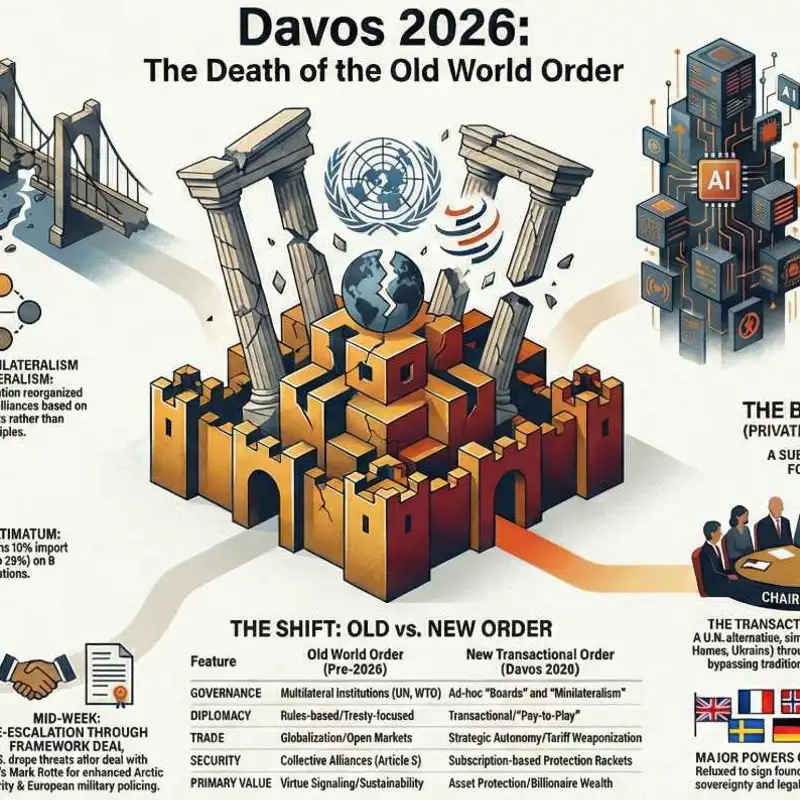
🏔️ Davos 2026: Global Leaders Confront AI and Geopolitical Tensions
Welcome back to the deep end. Today, we're doing something, a little different. We're gonna be traveling metaphorically, at least, to the very, very recent future. We're looking at January 2026.
Roy:And the place is Davos, Switzerland.
Penny:Exactly. The fifty sixth annual meeting of the World Economic Forum.
Roy:Right. And, you know, usually when we talk about Davos, we're talking about these high minded panel discussions, fondue, snowy peaks.
Penny:Billionaires pretending to save the world. The whole billionaire summer camp thing.
Roy:Exactly. But looking at the sources we've got for this deep dive, the, the vibe in 2026 is completely different. It's it's unrecognizable.
Penny:I mean, the setting alone, you've got this tiny Swiss ski town population, maybe 10,000. Right. But it's occupied by 5,000 Swiss soldiers. Uh-huh. And you have f 35 fighter jets screaming overhead.
Roy:It's a militarized zone. And that visual, it really sets the stage. The official theme was a spirit of dialogue.
Penny:Which sounds nice.
Roy:It sounds nice, but we have this primary source that just it paints a totally different picture. It's a report from philstockworld.com called We Friday wrapping up the old world order.
Penny:Ah, yes. By Robo John Oliver or RJO. I have to say this source is fantastic. It just cuts through all the corporate PR nonsense.
Roy:He really does.
Penny:He calls the whole thing a hostage video instead of a conference.
Roy:It's a strong metaphor, but when you look at the details it kind of holds up. I mean this was not a conference about improving the state of the world.
Penny:Which is the W. A. F. Motto, right?
Roy:It is. No, this was a geopolitical stress test. Yeah. And all our sources agree on one thing, the rules based international order, you know that structure we've lived with since World War II, it didn't just crack at Davos twenty twenty six, it shattered.
Penny:Okay so we have a lot of broken pieces to sort through here. We've Donald Trump back on the world stage with this thing called the board of peace.
Roy:Which we definitely need to unpack.
Penny:We've got the Canadian prime minister, Mark Carney, giving what might be the most depressing speech in g seven history. And then there's this electron gap that's threatening the entire AI revolution.
Roy:It is a heavy stack. But I think we have to start with the most jarring part, the one that RJO highlights right at the top.
Penny:The board of peace?
Roy:The board of peace.
Penny:Let's get into this. When I first read that headline, I thought it was a joke. President Trump launches the board of peace. RJO says it sounds like a committee formed by suburban HOA presidents to ban sidewalk chalk.
Roy:He's not wrong, but it's very real policy. And to get why it matters, have to look at what it's replacing.
Penny:The UN.
Roy:For eighty years, we've had the United Nations, Mhmm. And it operates on this principle of multilateralism. So theoretically every country gets a voice, it's like a town hall.
Penny:Okay. So everyone gets a mic even if no one's really listening and the board of peace is what?
Roy:It's a country club. The reporting says it started as this oversight committee for the Gaza ceasefire Mhmm. But it just morphed into this global body designed to sideline the UN completely.
Penny:And the barrier to entry isn't diplomacy or anything like that.
Roy:No. It's capital. It's just cash.
Penny:The sources mention a specific number, a fee.
Roy:$1,000,000,000. No. That is the reported contribution for a permanent seat on the board.
Penny:Wait. I just I have to stop on that. A billion dollars.
Roy:A billion dollars.
Penny:So just so I'm clear, this isn't like commit a billion to aid programs or something like that. This is just the fee to sit in the chair.
Roy:That's the implication of the reports. It's it's the subscription fee for global influence. RJO makes this biting comparison to a Mar a Lago membership, you know. You pay a huge initiation fee, but you still have a food and beverage minimum. Right.
Roy:But geopolitically, this is this is a seismic shift. We're going from multilateralism to transactionalism. This a to play. If you can afford the subscription, you get a say in global security.
Penny:But doesn't that just break the entire idea of international law? I mean, you can just buy the judge, it's not a court anymore. It's an auction.
Roy:Precisely. And that's why the old world order is dead. In the old system, you had rights because you were a nation. In this new system, you have privileges because you're a customer.
Penny:And if you stop paying.
Roy:You lose access. Yeah. And this brings us to the Greenland incident because we saw this play out in real time at the conference.
Penny:The Greenland crisis. This part felt like a fever dream reading it. Trump threatened a 10% tariff on eight European nations because he wanted to buy Greenland. Again.
Roy:It wasn't just about buying it. It was about securing it. Yeah. You know, the argument was national security against Russia and China.
Penny:Okay.
Roy:But the mechanism he used was just brute force economics. It was give me this territory or I will crush your export markets.
Penny:I saw Ursula von der Leyen called it a mistake and Macron was threatening a trade bazooka. It sounded like a full blown trade war was about to kick off.
Roy:Yeah. They postured for sure. But look at how it ended. Did Trump apologize? Did he back down?
Roy:No. He got a framework for joint control. He didn't use soldiers. He used tariffs as a weapon to literally erode another country's sovereignty. And that sent a chill through the entire conference.
Penny:Because it proved that security is now just a negotiable asset. You can trade it away.
Roy:Exactly. It seems like the European leaders were just they were completely caught off guard. Like, came to play chess and Trump showed up to foreclose on the building.
Penny:That's good way to put it. And it really sets the stage for the second pillar here. Because in the middle of all this chaos, you have Mark Carney.
Roy:The former head of the Bank of England, former Bank of Canada governor, the ultimate insider.
Penny:Right. And he gets up and delivers what is essentially a eulogy for the West. RJO calls it the most honest speech in Davos history.
Roy:Which is saying something considering the usual fluff you hear there. Carney got on stage and basically performed an autopsy. His main point was and I'm quoting here, the rules based international order is over. It was always partly a lie and nostalgia won't bring it back.
Penny:Okay, let's stop on that phrase. It was always partly a lie. That is a massive admission from a G7 leader. What's the lie he's admitting to?
Roy:It's what political scientists sometimes call the useful fiction.
Penny:A useful fiction?
Roy:Yeah. The idea was that all nations follow the same rules, you know. Don't invade your neighbors. Respect human rights. Free trade.
Penny:The standard stuff.
Roy:The standard stuff. But the West, and I mean specifically The US, they they often exempted themselves from those rules. Think about the Iraq invasion or The US refusing to join the International Criminal Court.
Penny:So the rules applied to everyone else, but not always to the sheriff.
Roy:Exactly.
Penny:So why did everyone else go along with it for so long? If we knew the sheriff was corrupt, why didn't we just fire him?
Roy:Because of what they call public goods. Yeah. This is the core of it. The US was hypocritical, yes, but in exchange, they provided things everyone needed. They kept the shipping lanes open with their navy.
Roy:They stabilized the global financial system with the dollar. They provided security umbrellas for Europe and Asia. It was a trade off. We accept your arrogance because you keep us safe and rich.
Penny:Okay. That makes sense. It's a protection racket, but at least you actually get the protection. So what changed? Why is Carney saying it's over now?
Roy:Because the trade off is broken. Carney's point is that the hegemon, The US, is no longer providing those goods for free. It's monetizing them. As he put it, hegemons cannot continually monetize their relationships. If the sheriff starts charging you a billion dollars just to pick up the phone, he's not a sheriff anymore.
Penny:He's a mercenary.
Roy:He's a mercenary. So if you're Germany or Japan or Canada Right. You're suddenly realizing the sheriff might actually rob you if you don't pay up.
Penny:So what's the move? Do they just give in?
Roy:Carney argues for strategic autonomy. He's basically telling all the middle powers that they need to band together. They need to hedge. They can't just be customers of American security anymore because the price is becoming extortion.
Penny:It's like realizing your landlord is erratic, so you and the other tenants try to pool your money to buy the building next door.
Roy:That is a great way to put it. But then look at how the landlord reacted. What happened right after Carney's speech?
Penny:Oh, this was so petty. Trump uninvited him from the Board of Peace.
Roy:Rescinded the invitation, to use the official term.
Penny:It's just, it feels so high school, like you said something mean about me so you can't sit at our lunch table.
Roy:It is petty but it's also highly strategic. It's a signal. In this new order, loyalty or at least silence is the real currency. You don't get a seat by being right. You get a seat by being compliant.
Roy:Carney pointed out the emperor had no clothes, so the emperor kicked him out of the palace.
Penny:So we have the political order collapsing into this this pay to play scheme. But Davos is also about the future. Right? The fourth industrial revolution. And you can't talk about 2026 without talking about Elon Musk.
Roy:Musk was everywhere. And you have to remember, in 2026, he isn't just a CEO. He is the head of the Department of Government Efficiency. He is the government.
Penny:And RJO calls his big presentation a masterclass in vaporware. He sat down with Larry Fink from BlackRock. What was the pitch?
Roy:Robots. The pitch was robots. Specifically, that robots will outnumber humans and that every household will want one.
Penny:He said people would want one to watch their kids.
Roy:Yes. That particular comment raised some eyebrows.
Penny:I have to say, I'm totally with RJO on this one. It sounds like the plot of every sci fi horror movie ever made.
Roy:It does have that vibe.
Penny:Like, I'm sorry Dave, I can't let you put the toddler to bed. Who hears autonomous robot and immediately thinks, perfect a babysitter?'
Roy:Safety concerns aside, the skepticism in our sources is really about the timeline. Musk claimed AI would surpass human intelligence by the end of this year or you know next.
Penny:He's been saying next year for fully autonomous driving since what 2016? It's like the sign in the bar that says free beer tomorrow. It's always just over the horizon.
Roy:RJO calls it the rapture prediction. Always imminent, never arriving, but it serves a purpose, right? It drives the stock price. It maintains this aura of inevitability. But if you want the real insight on AI from this conference, you have to look away from Musk and toward Jensen Huang from Nvidia.
Penny:That the guy who actually builds the hardware. Exactly.
Roy:We have notes from no prior podcast analysis of this talk. And Wong isn't selling this fantasy about robot nannies. He's describing a huge structural shift. He argues we aren't in a bubble, we're in a transition to accelerated computing.
Penny:What's the distinction he's making there?
Roy:It's this task versus purpose framework. And this is really useful. Huang says AI will take over tasks, the drudgery, the coding, the data organization.
Penny:Okay.
Roy:But humans retain the purpose. It isn't about replacing humans. It's about retooling our entire industrial base to be faster, more efficient.
Penny:That sounds I mean, sounds more optimistic. We keep the purpose. AI does the grunt work. But even with that view, there's a wall, a physical wall.
Roy:The electron gap.
Penny:The electron gap.
Roy:This is maybe the most critical technical takeaway from the whole thing and we really need to spend a minute here because it explains why the AI revolution might just stall out.
Penny:Okay. So what is it?
Roy:We are building chips faster than we can build power plants.
Penny:Wait, I want to drill down on that. We always hear we need more energy, but why is it a gap? Can't we just build more solar panels?
Roy:It's not that simple. AI data centers need massive, constant baseload power. They run two forty seven at peak capacity. Wind and solar. They fluctuate.
Roy:The sun sets, the wind dies. You need nuclear or natural gas for that steady Right. But here's the problem. It takes five to ten years to permit and build a new power plant or a big transmission line. It takes one year to build a new chip factory.
Penny:So the math just doesn't work. We're building the engine of a Ferrari but we don't have enough gas to run it.
Roy:That's it. Exactly. We are hitting the physics limit. And RJO and other sources point out that this electron gap is the real bottleneck and this ties the tech conversation right back to the geopolitical one.
Penny:How so?
Roy:Because if energy is the constraint, then sovereignty is energy. It doesn't matter if you have the world's smartest code if you don't have the gigawatts to turn the server on. We're entering a phase where national power is going to be measured in electricity production.
Penny:Oh if you're a country that relies on energy imports, you are in serious trouble.
Roy:Deep trouble. You can't be an AI superpower if you can't keep the lights on. This is why you see companies like Microsoft and Amazon trying to literally buy nuclear plants. They see the grid can't support their ambitions.
Penny:It all feels so heavy. You look at the politics and it's just transactional bullying. You look at the tech, and it's a physics crisis. What was the actual mood on the ground? RJO called it a surrender ceremony.
Roy:That phrase really stuck with me. Surrender ceremony.
Penny:Yeah. He describes the promenade, that main street in Davos where companies rent storefronts and usually he says it's plastered with sustainability, ESG, DEI, you know all the save the world stuff.
Roy:And this year, silence. The New York Times source we have noted that the virtue signaling shifted completely. It wasn't about signaling virtue to the public or climate activists anymore.
Penny:Exactly,
Roy:it's a survival mechanism. The business elites they realize the old rules don't protect them anymore. If Trump can put a tariff on a country over Greenland, he can certainly destroy a company that talks too much about carbon footprints. They were just they were scared.
Penny:So everyone just fell in line?
Roy:Mostly. I mean, Macron had his moment, the sunglasses speech, where he warned against the law of the strongest.
Penny:Right. Wearing sunglasses indoors while talking about a dark future.
Roy:A bit of theater. But practically, Europe is scrambling. They're signing trade deals they hate. They're buying weapons they can't afford. They're hoping compliance will buy them some safety.
Penny:But as we learn with the Board of Peace, the subscription price can always go up.
Roy:That is the defining feature of this new normal. We've moved from a world of treaties, which are static, written down, binding to a world of transactions. Transaction happens once. Then you have to negotiate the next one. Peace is a service you pay for, month to month.
Penny:RJO concludes his report by saying, This isn't a transition period where things will eventually return to normal. This is a rupture.
Roy:And that rupture, it changes the calculus for everyone. If Carney is right and that useful fiction is gone, then we're looking at a very old, very harsh reality. Thucydides wrote about it thousands of years ago, it's the strong do what they can and the weak suffer what they must.
Penny:That's a terrifying thought for the 20 century. I mean, we thought we had moved past that.
Roy:We thought the institutions would save us. But institutions are just people and agreements. And if the people stop agreeing, the institution just vanishes.
Penny:It really forces a question on us then. We're talking about billion dollar entry fees. We're talking about massive energy infrastructure just to run AI. If you're a superpower, you can pay. You can build.
Roy:But what if you aren't? What if you're a developing nation or even a smaller European country?
Penny:Right. What happens to the countries that can't afford a seat at the table?
Roy:Exactly. Mean, we moving toward a future where global governance, you know, having a voice in your own fate is strictly a luxury good? If you can't afford the buy in, are you just a spectator to your own history?
Penny:Sovereignty as a luxury good, that is going to keep me up at night.
Roy:It should. It changes everything about how we understand the world map.
Penny:Well, we promised a deep dive and I think we hit the bottom. It's a brave new world out there.
Roy:One.
Penny:Thanks for joining us in the deep end. We'll see you next time.