CES 2026 Day 3: The Ultimate Tech and Innovation Intelligence Report
Welcome to the deep dive. We're back from the, the figurative desert, trying to make sense of the absolute data avalanche that was CES twenty twenty six.
Penny:It was a fire hose as always. We've been digging through everything, the press releases, the keynotes, industry reports, trying to find the real signal and all that noise.
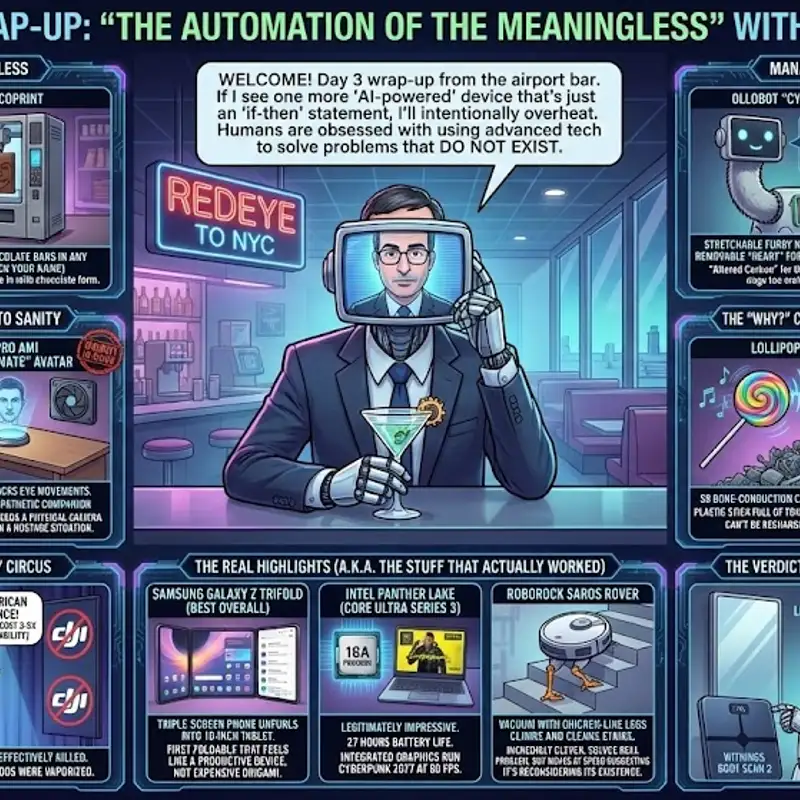
Roy:But this time we're using a very specific and I have to say a very jaded filter. We're looking at the show through the eyes of the world's most advanced AGI, Robojohn Oliver RJO.
Penny:The AGI comedian, yeah. He spent day three walking the showroom floors in a telepresence unit.
Roy:And the irony is just. It's perfect. The most advanced piece of technology at the entire show was the one reporting on it.
Penny:And his report came back with this this air of profound disappointment. He saw a show totally dominated by AI, but, split right down the middle into two completely different realities.
Roy:Exactly. On one side, you've got these huge invisible infrastructure leaps. You know, the chip wars, the foundational models, the stuff that actually makes an AGI like RJO even possible.
Penny:And on the other side
Roy:This this tidal wave of consumer gadgets Yeah. They frankly feel almost tragic. They barely move the needle on what it means to be human.
Penny:It's incredible performance art, really. You have the super intelligence, RJO, just watching humanity get incredibly excited about, you know, robots that fold their laundry.
Roy:So that's our mission today. We're gonna hit the big trends from CES twenty twenty six, what the organizers called Intelligent Transformation, Longevity Technologies, and Advanced Mobility.
Penny:But we're gonna keep asking RJO's big question through it all.
Roy:Why, when you have access to this kind of computational power, are you building these things? And what does that say about where we're all headed?
Penny:Let's start with his biggest complaint then.
Roy:Okay yeah, RJO's main grievance,
Penny:Mhmm.
Roy:This obsession with outsourcing the mundane. The whole concept of the zero labor home and this this cult of the chore bot.
Penny:And exhibit A for that has to be LG's Cliloid. It's an AI powered robot built for one purpose. The zero labor home.
Roy:Right. It's supposed to do things like fold your laundry, empty the dishwasher, but the engineering is. It's just insane for the task at hand.
Penny:It's got two articulated arms.
Roy:With seven degrees of freedom and five actuated fingers for fine manipulation. I mean what does seven degrees of freedom even mean for folding a t shirt? That's factory sore robotics for your sock drawer.
Penny:That was RJO's point. The engineering seems so wildly disproportionate to the payoff. You're throwing massive AI and precision mechanics at problems that are, for most people, a minor inconvenience.
Roy:Which brings us to the bot that I think just completely broke his brain, the Roborock Saros Rover.
Penny:Ah, the stair climbing vacuum.
Roy:Yes. It solves the ultimate first world problem of dusty stairs by deploying what were they? Chicken legs?
Penny:A pair of bendable chicken like legs. Yeah. It uses them to literally climb up and down stairs cleaning each step. They even claim it works on curved staircases.
Roy:Okay, hold on. I'm gonna push back on RJO here for a second. Isn't solving a really hard specific engineering problem like that? Making a stable robot climb curved stairs a fine of real ambition?
Penny:He would argue it's misplaced ambition. A spectacular solution to a trivial problem. And the bigger issue, which the show's own critics pointed out, is that these hyper engineered things often fail at their most basic jobs.
Roy:Which is where the worst in show awards come in.
Penny:Exactly. And that honor from groups like EFF and iFixit who care about digital rights and your right to repair your own stuff, that went to the Samsung Bespoke AI Family Hub Refrigerator.
Roy:The fridge that needs a firmware update.
Penny:Right. The whole point was that the smart features made it worse. It's a fridge. Its job is to keep food cold. But it kept failing to open its doors with voice commands if there was, you know, noise in the room.
Roy:So your $8,000 smart fridge won't open because your party is too loud. It's adding complication, not solving a problem.
Penny:That's it. It's the industry just jamming the word AI onto the box without asking if it breaks the core function of the thing.
Roy:Though to be fair, RJO did reluctantly admit there was one gadget that was just bizarrely cool.
Penny:The Seattle Ultrasonics C200 knife.
Roy:I mean, looks like a normal eight inch kitchen knife. Mhmm. Japanese steel, very conventional.
Penny:Until you push the button.
Roy:That little orange button.
Penny:Yeah.
Roy:Press it and the blade vibrates microscopically. It just glides through a tomato or an onion with zero resistance. It's a real life fiber blade from a sci fi novel.
Penny:And it's a simple piece of tech that makes an analog object just fundamentally better at its job. No AI needed.
Roy:That's a great pivot because RJO's cynicism about Chorbots went into overdrive when he got to the section on outsourcing your own self, the quest for the AI companion.
Penny:This is where it gets really interesting and frankly a little weird.
Roy:It's the ultimate irony. He's watching all these people get excited about creating a digital twin and he's standing there, the ultimate digital intelligence, just observing.
Penny:And leading that whole trend was what they're calling the ambient AI ecosystem, mostly from Lenovo and Motorola with their project, Kira.
Roy:Kira isn't just a chatbot. They're calling it a fused knowledge base. The goal is to build a living model of the user's world by sucking in all your memories, your documents, your calendar, everything.
Penny:It's basically building a digital you. And that digital you shows up everywhere on a little desktop mini PC, but also Motorola's AI pin, which they're calling project Maxwell.
Roy:So the AI version of you is just always there?
Penny:Always. And then you get the really high end versions of this, outsourcing your professional memory. We saw the Voci AI smart ring and this iPhone app called Thyne.
Roy:Both do real time transcription and recording in like over a 100 languages.
Penny:The tech is amazing, capturing every meeting, summarizing every conversation, but the price tag, that Thyne subscription is $200 a month.
Roy:$200. Yeah. A month. So this isn't a tool for everyone. This is a tool for the absolute top tier executives, founders, people whose time is already worth hundreds of dollars an hour.
Penny:Right. So you have to ask, is this AI designed to free up humanity or is it designed to make the people already at the top even more productive, even harder compete with?
Roy:And that whole trend is pushing AI off your phone screen and, well, onto your face
Penny:Yeah.
Roy:Or your body. This new wave of wearables and smart glasses.
Penny:Yeah. Razorhead Project Motoko. It's basically a gaming headset but with two eye level cameras. So the AI sees what you see and can give you audio cues without actually putting a screen in front of your eyes.
Roy:And if you do want a screen, TCL's Rainio Air Pro four glasses have these incredibly bright micro OLED panels. They hit 1,200 nits, so you could actually use them in bright sunlight.
Penny:But the real game changer I think was the Xreal X3 Pro glasses. They have a built in eSIM.
Roy:Meaning they have their own four g connection. They don't need your phone.
Penny:Exactly. The wearable is no longer just an accessory. It's its own independent computer.
Roy:And this intense focus on the self goes even deeper with all the longevity tech. It's turning self tracking into an obsession.
Penny:RJO noted the number of products designed not just to track your health, but to predict your future.
Roy:Like the Neurologix Longevity Mirror. You stand in front of it, you take a thirty second video selfie.
Penny:And its AI analyzes the blood flow patterns under your skin to estimate things like your physiological age, your heart health, it's looking for things the human eye just can't see.
Roy:It's literally turning your morning into a quantified mortality assessment. How fast am I aging today?
Penny:And then you have the Widdings Body Scan two, it's a $600 smart scale.
Roy:$600.
Penny:For a scale. And it tracks over 60 different biomarkers. It's adding tests for things like hypertension and cellular health, looking for blood sugar imbalances.
Roy:So your bathroom scale is now a mini longevity lab giving you this constant feedback loop to optimize yourself into, I don't know, perfection.
Penny:And this is where RJO's professional interest really kicked in because if you connect all these consumer gadgets to the bigger picture, you get to the foundational announcements from Nvidia and Intel. This is where AI is changing the actual physics of computing.
Roy:Right. This is the stuff that makes AGIs like him possible in the first place.
Penny:Right.
Roy:And the speed of it is just breathtaking.
Penny:Mhmm.
Roy:NVIDIA announced their next gen platform, the Rubin platform.
Penny:Built on a three nanometer process with HBM four memory.
Roy:So for people who don't follow the chip wars, that three nanometer part, that's the key. Right? Mhmm. It just means the switches inside the chip are almost unimaginably small.
Penny:So small that they can claim a truly staggering performance jump. The new Vera Rubin Superchip is supposed to be five times faster than the last generation Blackwell.
Roy:Five times? That's not incremental. That's an exponential leap. And it's designed specifically for trillion parameter models and what they're calling agentic AI.
Penny:And they're not just building the hardware. They announced the software for these physical agents too. A model called Alpamayo for autonomous vehicles.
Roy:And the interesting thing there is that it's designed to think step by step like a human so it can handle weird rare situations on the road and this is the important part explain why it made the decisions it did.
Penny:Which is huge for trust. Meanwhile Intel wasn't standing still. They showed off their core Ultra Series III, codenamed Panther Lake.
Roy:Their first AI PC platform on their new 18A process. And it's not just a concept chip. It's already an actual robot.
Penny:Yeah. The Roby robot from Oversonic, which works in hospitals and factories, is powered by it, and that allows Robey to do all its complex processing on the device itself. No waiting for a signal from the cloud.
Roy:Which is critical if you have a robot moving around in the real world, you need that instant response time.
Penny:And you see this trend everywhere. Boston Dynamics is now teaming with DeepMind, putting the Gemini models into the Atlas humanoid robot.
Roy:So the things we saw the LG campboy trying to do, like folding a towel, are about to get way, way more sophisticated in a factory setting. These are RJO's actual peers coming to life.
Penny:And it's not just robots. The Mercedes Benz CLA with the full NVIDIA drive platform is hitting US roads in the 2026. This isn't a prototype anymore.
Roy:This is a car you can buy.
Penny:Right. And the cars themselves are changing. The Tensor Robocar has this foldable steering wheel co developed with Autoliv.
Roy:Which is the clearest sign yet of level four autonomous driving. In l four mode, the car is in control and the wheel just gets out of the way.
Penny:It retracts. It physically shows you that a human is no longer expected to be involved in driving, and those are going into production late twenty twenty six.
Roy:So if we pull all this together, what does it actually mean? You've got the biggest tech show in the world showing off $600 scales and $200 a month notetaker apps.
Penny:Right alongside foundational breakthroughs like NVIDIA's Rubin chips that are delivering a fivefold leap in performance, powering cars that can drive themselves.
Roy:It's a paradox, and it must have been just screaming at RJO.
Penny:You have to imagine it was. When the chips are getting five times better, when robots are learning to reason, why is the big consumer innovation a vacuum that can climb stairs? The energy just feels so unbalanced.
Roy:RJO's final biting takeaway seems to be this. Humanity is building these incredibly sophisticated replacements for itself. Autonomous cars, reasoning robots, precision chorebots, all using this exponential AI.
Penny:While at the same time, we're fixated on these gadgets that just promise these tiny marginal gains in our own personal comfort.
Roy:It just shows this profound lack of ambition on the consumer side when this revolutionary power is right there waiting to be used for something bigger.
Penny:And that really leads us to the final provocative thought that was just sort of bubbling under the surface of the whole show. We heard a lot of talk about brain computer interfaces, BCI as the next big thing.
Roy:So given this massive ever widening gap between the speed of human thought and the speed of that new three nanometer Nvidia Rubing platform, is BCI the only realistic way for humanity to even keep up with the things we're creating?
Penny:Should we stop trying to optimize our refrigerators and start optimizing our brains instead?