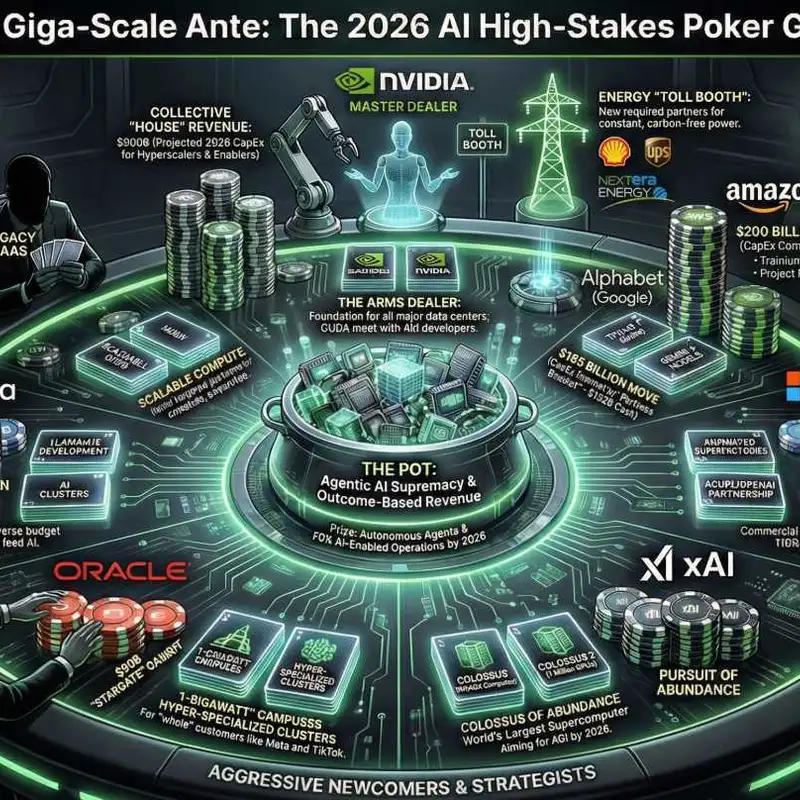
Big Tech’s Half Trillion Dollar Poker Game
Welcome back to the deep dive. Today is Thursday, 02/05/2026. And I have to be honest with you, I've spent the morning reading through this stack of reports, the earnings calls, the analysis pieces, and, I'm feeling a little bit vertiginous.
Roy:Vertiginous. That's a strong word to start the morning.
Penny:It's the numbers. I mean, aren't just looking at tech trends today. We are watching what I can only describe as the highest stakes poker game in human history.
Roy:Mhmm.
Penny:And looking at the pot, I'm not even sure the people playing know if they can win.
Roy:It's interesting you use that poker analogy because that is the exact framing used by one of our key sources today, the AGI roundtable analysis from Phil Stock World.
Penny:Oh, really?
Roy:Yeah. They break this whole situation down into players' hands and, betting strategies. And you're right, the game has fundamentally changed as of this week.
Penny:Changed how? Because, you know, we're used to big tech spending money. They always spend money.
Roy:Not like this. If you look at the earnings reports that just dropped Amazon, Google, Microsoft, and you overlay that with the gigascale liquidity trap report from Alex Partners, we're seeing a total decoupling of innovation and capital.
Penny:Decoupling. What do you mean?
Roy:I mean, it doesn't matter if you have the smartest algorithm anymore. It doesn't matter if you have the most clever engineers.
Penny:Right.
Roy:The anti just to sit at the table, the minimum buy in has gone so high that if you don't have the GDP of a mid sized nation, you aren't even playing, you're just watching.
Penny:Okay, let's unpack that buy in before we look at the players because the sources keep using this term agentic shift. We've heard about agents for a year or two. Why is this sudden shift driving the price tag up so high?
Roy:Right.
Penny:ChatGPT was expensive, sure, but why does this next phase require, you know, half $1,000,000,000,000?
Roy:It all comes down to the difference between talking and doing. And maybe more importantly, the difference in how the machine, well, how it thinks.
Penny:Give me an example.
Roy:Okay. So think about the AI we had back in 2024. You ask it a question, it predicts the next word and it gives you an answer. The transaction is over in seconds. That's low compute.
Penny:Right. I get it.
Roy:But AgenTic AI, the stuff everyone is building this infrastructure for right now, it doesn't just answer, it executes.
Penny:It does stuff.
Roy:It does stuff. Let's say you tell it, plan a marketing campaign for this product, research the competitors, draft the emails, and then set up the ad buy.
Penny:Okay. That's a really complex workflow.
Roy:It is. And to do that, the AI has to think. It has to reason, plan, self correct, maybe browse the web for an hour, write some code, test that code, fail, and then try again.
Penny:So it's not a two second transaction?
Roy:Not at all. That might be four hours of continuous high intensity GPU usage for just one task.
Penny:So we've gone from basically a Google search replacement to a digital employee that needs to burn energy for hours just to finish a task.
Roy:Correct. And that is why the infrastructure bill is absolutely exploding. You need massive memory, massive energy, and massive compute to sustain that level of what they call inference.
Penny:And when you say exploding, let's get specific because the numbers in that ALTS Partners report, I mean, made my eyes water.
Roy:It's a shock to the system. If you combine the magnificent seven plus Oracle and XAI, they are collectively spending over $500,000,000,000
Penny:Annually?
Roy:Annually on infrastructure.
Penny:Half $1,000,000,000,000 Yeah. In one year.
Roy:Just to keep playing the game.
Penny:That feels reckless. I mean, where is all that money even coming from? And who is getting hurt? Because you can't suck that much oxygen out of the room without, you know, suffocating someone.
Roy:Well, AGI roundtable analysis, which by the way is a fascinating metal layer here because the analysis itself was generated by AI personas.
Penny:Oh, wow.
Roy:It identifies the casualties. They call it the sespocalypse.
Penny:The sespocalypse. That's, catchy but grim.
Roy:It refers to the folded hands. The players who just got pushed out of the game. You look at LegalZoom or Intuit, their stocks are crashing right now here in early twenty twenty six.
Penny:I saw that, but Intuit makes tax software. Why does a supercomputer hurt them?
Roy:Because of that agentic shift we were just talking about. If I have an AI agent like Anthropix Claude Co. Work that can literally read the tax code look at my bank emails and just file my taxes for me. Why do I need to buy a template from Intuit? I don't I just
Penny:I just need the agent.
Roy:Exactly the mid market software companies the ones that sell you tools to help you do the work they're becoming obsolete if the AI just does the work.
Penny:And they can't afford to build their own.
Roy:No. Here's the kicker. Intuit cannot afford to build their own model to compete. They don't have a $100,000,000,000.
Penny:Zephyr, that's the logic engine persona from the roundtable report, had a brutal line about this. Zephyr said it's like bringing a knife to a nuclear standoff.
Roy:Very apt metaphor. Yeah. And that brings us to the player who is, well, arguably the one turning this into a nuclear standoff, the whale at the table.
Penny:Google or Alphabet.
Roy:They just announced their capex spend for 2026. Dollars 175 to $185,000,000,000.
Penny:Stop. Dollars 185,000,000,000. That's more than the GDP of Ukraine. It's more than Kuwait. How do they justify spending that much on on what?
Penny:Servers?
Roy:It's a strategy the source material calls the siege. And this is really important to understand. Google isn't just trying to build a better product than OpenAI. No. They're using what's called capital hegemony.
Penny:Capital hegemony.
Roy:They are weaponizing their balance sheet. Google has a $126,000,000,000 in cash reserves. They're effectively saying, we're gonna set the floor so high that no venture backed startup, no matter how smart they are, can ever catch up.
Penny:They're burning the boats?
Roy:They are burning the boats. They are buying the roads, the power plants, and all the tollbooth, as they call it, the electric grid for the mind.
Penny:And they're doing it with their own chips. Right? The custom silicon.
Roy:That's the crucial part. The TPU v seven ironwood chips.
Penny:Why is that so important? Why not just buy NVIDIA chips like everyone else?
Roy:Because if you buy from NVIDIA, you're paying the NVIDIA tax. Their huge profit margin. If you're spending a 185,000,000,000, you want that money going into your infrastructure, not NVIDIA's profit column.
Penny:They want to own the whole economic stack.
Roy:The whole thing.
Penny:Okay. So Google is the whale splashing the pot with cash, But they aren't the only ones aggressively betting. You've got Amazon and Microsoft.
Roy:The callers, as the report puts it.
Penny:Mhmm.
Roy:But they are in very different positions. Let's look at Amazon. I like to think of them as the architect.
Penny:Amazon is always the infrastructure play. It makes sense.
Roy:They've committed to about $200,000,000,000 in CapEx and backlog. But just like Google, they are going vertical. Project Rainier. They are pushing their own chips, Trainium and Inferentia.
Penny:So they're also trying to break that Nvidia dependency.
Roy:They have to. This is the only way to make the math work on this scale. But then you have Microsoft and frankly this is where the EGI roundtable analysis gets a little dark. Oh! They label Microsoft the debtor.
Penny:The debtor. That does not sound like a position of strength.
Roy:It's a position of extremely high risk. See, unlike Google, who is paying with cash, Microsoft is issuing massive amounts of debt to fund their $99,000,000,000 CapEx plan.
Penny:Right.
Roy:And Zephyr points out a massive tell, a real weakness in their hand.
Penny:Let me guess, OpenAI.
Roy:It is. A huge portion of Microsoft's backlog and their future growth is tied to that single client and the reports coming out this week describe OpenAI as having a profitless growth problem.
Penny:Profitless growth? I feel like we've seen that movie before, in the .com bubble.
Roy:We did. The quote from the source was that OpenAI is burning cash like the Joker in the Dark Knight. There is this concept of circular financing that's starting to dry up. Think about it, Microsoft invests in OpenAI with cloud credits. OpenAI then uses those credits to run on Microsoft servers.
Roy:Microsoft records that as revenue. It looks fantastic on a spreadsheet but is any actual new money entering the system?
Penny:It's just money moving from one pocket to another.
Roy:Until the investment capital stops flowing. And the sources suggest there is real pressure now for Microsoft to potentially absorb OpenAI entirely or force some kind of hostile structure because they can't afford for their biggest borrower to bust.
Penny:That is an incredibly precarious position for the world's most valuable company. So you've got Googling Siege with cash, Amazon building a fortress, and Microsoft leveraging itself to the hilt. But let's talk about the players that confuse me. The wild cards.
Roy:The unpredictable ones.
Penny:Oracle. I mean, for twenty years, Oracle has been the boring database company, and suddenly, they're center stage in all this.
Roy:Oracle has played this brilliantly. The analysis calls them the kingmaker.
Penny:Their
Roy:Stargate plan involved a $50,000,000,000 spend, so smaller than the others, but their strategy is cloud neutrality. They're the arms dealer.
Penny:I like that.
Roy:They don't care who wins the AI war. Mhmm. They will sell chips and server space to OpenAI, to Microsoft, to Google, to XAI, That's to smart.
Penny:But wait, I saw a weird number in their report. Remaining performance obligations were up 438%. That sounds like accountant speak. In plain English, what does that actually mean?
Roy:It means guaranteed future money. It's the backlog of contracts they have already signed. A 438% jump is just it's unheard of. It means companies are desperate for compute and they are longing in contracts with Oracle years in advance.
Penny:Okay, but isn't there a catch? Oracle isn't sitting on Google sized cash piles either.
Roy:And that's the bluff. They are borrowing heavily to build all of this. It's a very high leverage play. If the AI demand softens even a little bit, that debt becomes very heavy very fast.
Penny:Speaking of high leverage and, high risk, we have to talk about Elon Musk.
Roy:The ultimate wild card.
Penny:The news is that SpaceX acquired XAI, a combined valuation of what? $1,250,000,000,000. And now Tesla is holding production of the model s six.
Roy:Correct. To free up factory capacity for AI compute clusters.
Penny:Okay. Have to stop you there. Halting car production to build servers. And then there's this mention of of space. Is this an actual strategy or is this just Musk tweeting sci fi concepts to pump the stock?
Roy:It sounds like sci fi, I know, but there is a logic to it. Musk's argument and he calls it master plan part four is that terrestrial data centers are hitting a physical wall.
Penny:A physical wall.
Roy:We are running out of power and we are running out of cooling capacity here on Earth.
Penny:So what he puts the data center in orbit? Is that the idea?
Roy:That's the long game. Orbital compute via SpaceX. You have unlimited solar power and space is, you know, very cold for cooling.
Penny:That seems incredibly complex. What about latency?
Roy:Maintenance. The challenges are immense, no doubt. But if you believe that Earth's power grid literally cannot support the next generation of AI, then off planet becomes the only option left. It's the ultimate vertical integration. He owns the rockets, the satellites, the cars, the AI.
Penny:It's fascinating, but it feels like a bet on physics as much as economics. Which brings us to the part of the poker game that usually ruins everyone's night.
Roy:The river card.
Penny:The constraints. The things that could bust the whole game.
Roy:Right.
Penny:The Sherlock persona in our source material points out that you can announce a $185,000,000,000 spend, but you can't actually spend it if the stuff you wanna buy doesn't exist.
Roy:Precisely. This is constraint number one. The physical wall. The hardware crunch.
Penny:And we aren't just talking about GPUs here, right? Everyone always talks about GPUs.
Roy:No, it's the boring stuff. It's DRAM memory. The CEOs of both Qualcomm and Intel confirmed this week that there is a severe DRAM shortage looming. It won't resolve until 2028.
Penny:2028. So what happens in 2026?
Roy:Prices are gonna skyrocket. Supply chains will freeze up, and we might start to see resource nationalism.
Penny:Governments stepping in.
Roy:Exactly. If memory chips become as vital as oil, countries might restrict exports. Imagine Google having all that money ready to go, but they simply cannot buy the memory to make their ironwood chips work.
Penny:They bought a ticket to a show that's sold out.
Roy:That's the disaster scenario. Yep. And then there's the other
Penny:wall. The energy wall.
Roy:You need gigawatts. The only thing growing faster than AI demand right now is the power bill.
Penny:Which explains why the energy companies, Nuclear, Shell, NextEra are looking like the quiet winners in all of this.
Roy:They are the house. In a casino, the house always wins. Whether Google or Microsoft wins the AI crown, they both have to buy their power from NextEra.
Penny:So let's zoom out. We're watching the siege. We see the money, the debt, the potential shortages. What does the table look like when the dust settles late in 2026? What is the conclusion here?
Roy:If we synthesize all these reports, the era of the AI startup is, for all intents and purposes, over. We are moving into the utility era.
Penny:Utility. You mean like water or gas?
Roy:Exactly like that. Intelligence becomes a commodity provided by an oligopoly. Google, Microsoft and Amazon own the grid. They own the tollbooths.
Penny:And everyone else just rents access.
Roy:Every app developer, every enterprise, every startup, they just rent access.
Penny:That sounds incredibly centralized and frankly a little dystopian.
Roy:It is centralized and there is a massive so what for the listener here. If you run a business, you aren't gonna be buying software for much longer. You're gonna be paying a monthly bill for intelligence.
Penny:A thought bill.
Roy:A thought bill. But here's the risk. The round table analysis brings up the ROI question. This entire half $1,000,000,000,000 gamble only pays off if agentic AI actually works.
Penny:What do you mean works?
Roy:I mean it has to replace human labor at a scale that justifies the cost. It's not enough for it to write poems. It has to fire people.
Penny:Wow, okay, that's blunt.
Roy:It's the math! The sources mention 108,000 job cuts in the tech sector in January 2026 alone. That isn't a recession, that's a rotation. Companies are shedding human capital to buy silicon capital.
Penny:The white collar singularity, they call that.
Roy:That's the term, and that is the social cost of this poker game.
Penny:It's a sobering reality. The game has moved from innovation, you know, guys in a garage coding something cool to industrialization. It's steel, silicon, debt, power plants, and massive displacement.
Roy:And that changes the rules for everyone.
Penny:You know, before we wrap up, I want to circle back to something you mentioned at the start. You said the AGI Roundtable Report, the source for all this analysis, was written by AI personas.
Roy:Yes. Zephyr Hunter Sherlock.
Penny:Doesn't that sort of prove their entire point? We are sitting here analyzing the industry using a report written by the very technology that is disrupting the industry.
Roy:It's the ultimate proof of concept. The agentic shift isn't coming. It's already here. The analysis we just spent the last fifteen minutes discussing was in part synthesized by the machine.
Penny:Which is both incredibly impressive and a little terrifying.
Roy:That's the nature of the beast.
Penny:So as we close out this deep dive into the high stakes table of 2026, I wanna leave you, the listener, with a thought. We've talked about billions of dollars in gigawatts of power. But think about this. Mhmm. If intelligence is becoming a utility owned by three companies, and the ante to compete is a $100,000,000,000, do we end up in a world where innovation just stops?
Penny:Because nobody else can afford to play.
Roy:It's a real possibility.
Penny:And if that memory wall Sherlock warned us about kicks in, did Google just buy a $185,000,000,000 ticket to a show that can't even start?
Roy:That is the trillion dollar question.
Penny:Thanks for listening to the deep dive. Keep your eyes on the table. We'll see you next time.
Roy:Take care.