10 Steps to Boosting Restaurant Traffic: A Case Study from the Trenches
Picture this, it's 02:00 on a Tuesday, you're standing in your restaurant, the lunch rush, if you could even call it that, is long gone.
Roy:And now it's just quiet.
Penny:So quiet. It's just you and the of the refrigerator. Maybe a server is wiping down a table for like the third time just to look busy.
Roy:Been there.
Penny:But mostly it's just empty seats and you're standing there and you're doing that mental math, you know? Yeah. Payroll, food costs, rent, the electric bill. And you're just thinking, where is everybody?
Roy:That is the universal nightmare of the small restaurant owner. It's that field of dreams fallacy just crashing down around you. You built it and they well, they came on Friday, but they're definitely not here now.
Penny:And that is exactly where we're starting today. We are doing a deep dive into basically a rescue mission. We've got this document and it reads less like a business textbook and more like a triage report from an ER. Right. It's called 10 Commandments for Maximizing Restaurant Revenue and Traffic.
Penny:It's by Phil Davis from Roundtable
Roy:And we should be really clear here, this is not some high level MBA theory about, you know, brand synergy. No. This is a case study from the trenches. Phil Davis and his team, they're fixers. They're the people you call when the ship is taking out water.
Penny:So speaking of the ship, the subject of this whole thing is a pizza shop. It's in Palm Beach County, but, we don't know the name.
Roy:No. And that's actually a really important point. Roundtable is super strict about confidentiality.
Penny:Which makes sense.
Roy:Yeah. They're dealing with a business owners. Well, they're dirty laundry. Yeah. The financial mess, the operational screw ups.
Roy:So keeping the client anonymous, lets us be brutally honest about what was going wrong.
Penny:I really appreciate that. It means we get the real story, not the PR version. So, okay, let's look at the patient. This pizza shop had good food. It had regulars who loved it, but traffic had just plateaued.
Penny:Yeah. And the owner was doing what I think most of us would do. He was just grinding, working harder.
Roy:The classic trap. He was trying to outwork a structural problem. He was working in the business, you know, making the pizzas instead of working on the business.
Penny:So roundtable comes in and spoiler alert they didn't tell him to buy a Super Bowl ad or anything. Nope. They went looking for what they call money hiding in plain sight. And the first place they looked, well that brings us to our first big topic, the margin trap.
Roy:This is the one that always makes people wince.
Penny:So the owner, he thought he had a winner. He had the sub combo sandwich, chips, a drink
Roy:The classic lunch special.
Penny:And it was flying out the door. Customers loved it. He was printing coupons for it, blasting it all over Facebook. It was his big volume drive.
Roy:It was driving volume. Sure. But it was what they called the busy but broke paradox.
Penny:Explain that. Because to me, a busy restaurant looks like a successful one.
Roy:Not if you're selling dollar bills for 90¢. Yeah. The consultants, they did a forensic accounting of that sub.
Penny:Like, down to the last pickle.
Roy:Every single ingredient, the cold cuts, the cheese, the bread, the packaging, the labor time to assemble it. And they realized that this sub combo, the one he was pinning all his hopes on,
Penny:What?
Roy:It was the lowest margin item on the entire menu.
Penny:Wait, so when you say low margin, was he actually losing money on it?
Roy:Once you've factored in the coupon he was using to drive all that traffic.
Penny:Yeah?
Roy:Yes. Effectively, yes.
Penny:Oh my god!
Roy:It was a losing trade. Every time a customer came in with that coupon, the owner was basically paying that person to eat his food. He was subsidizing their lunch.
Penny:That is terrifying. You're standing there. The kitchen is slammed. You're sweating. The ticket printer is just going nuts.
Roy:And you're digging yourself into a deeper hole with every single order.
Penny:Because he was just looking at the wrong number.
Roy:Exactly. He was probably looking at his food cost percentage and thinking, oh, 30% is fine. That's standard. But he wasn't looking at the contribution margin.
Penny:Which is the actual dollars left over.
Roy:The actual cash in your hand after the food is paid for. That's the number that pays the rent.
Penny:So what's the fix? Do you just kill the sub? I mean, your regulars would revolt.
Roy:No, you don't kill it. You never want to alienate your loyal customers but you stop treating it like the star of the show. Roundtable, they analyze the rest of the menu and they found three other items that had massive margins. The items that were actually keeping the lights on.
Penny:And people liked those too.
Roy:That's the kicker. They liked them almost as much. The gap in customer happiness was tiny, but the gap in profit was huge. So they just shifted the marketing focus.
Penny:So they changed the coupon?
Roy:Changed the coupons, retrained the staff to recommend the high motion pasta dish instead of the sub.
Penny:And what happened to the numbers?
Roy:Traffic stayed exactly the same. The same number of people walked in the door, but profit jumped immediately.
Penny:That's such a critical point. It wasn't about getting more people in, it was about getting the right orders from the people who are already there.
Roy:Right. If you don't know your margins, your marketing is just setting money on fire. You just can't promote something until you know exactly what it costs you.
Penny:Okay. So this leads to the practical side. How do you get people to order the profitable stuff without, you know, twisting their arm? And this brings us to menu psychology.
Roy:Which, I know, it sounds a little manipulative.
Penny:A little. The source calls it decision architecture. That sounds very Orwellian. Are we tricking people here?
Roy:I wouldn't call it a trick. Think of it like a map. You walk into a restaurant, you're hit with decision fatigue, you're hungry, you're talking, and now you have a list of 50 things to choose from. It's overwhelming.
Penny:Right.
Roy:A well designed menu just helps you make a choice. Yeah. It guides you.
Penny:The source compares it to a casino floor.
Roy:It's a perfect analogy. Yeah. A casino isn't random. They don't just throw slot machines anywhere. The whole layout is designed to guide you.
Roy:A menu should do the same exact thing.
Penny:Okay, so let's get specific. What's this upper right corner rule?
Roy:So eye tracking studies have shown this for years. When we open a menu, our eyes narrowly just zip to the upper right corner first. It's prime real estate.
Penny:It's the billboard.
Roy:It's the billboard. And what's usually there in a badly designed menu?
Penny:Appetizers or salads.
Roy:Exactly. Or whatever random thing happened to fit there. You're wasting your billboard on a $6 side salad.
Penny:So the advice is simple. Put your star player there, the high margin signature dish.
Roy:Put it in a box, make the description amazing, make it impossible to miss.
Penny:Okay, so now I'm looking at my notes here on decoy pricing, this is the one I feel like I fall for constantly.
Roy:We all do. Our brains don't judge prices in a vacuum, we judge them by comparison.
Penny:So give us the pizza example from the case study.
Roy:Okay, you have an $18 pizza combo. For some people that feels a little steep for lunch. Sure. If that combo is sitting right next to a $10 sandwich, the pizza looks expensive. But what if you place a $28 super premium truffle lobster pizza right next to it?
Roy:Ah.
Penny:Suddenly $18 feels like the sensible, smart option.
Roy:That's the decoy. The goal isn't really to sell the $28 pizza, though it's great if you do. The goal is to make the $18 item feel like a steal. You're anchoring their expectation.
Penny:You're making it the safe choice. That's fascinating. And it really gets back to that idea of working on the business. Let's talk about the physical space. The silent salespeople.
Roy:Atmosphere and signage. And in this Palm Beach shop, the silent salesperson was, basically asleep on the job.
Penny:The report says they were playing generic radio.
Roy:Which is just the death of a vibe. Generic means you didn't choose. The consultants said the music was fine, but fine is forgettable.
Penny:And they changed it based on demographics.
Roy:They did. They looked at who was actually living in the neighborhood. You know, if you're in a college town, you're playing soft jazz, you're sending the wrong signal.
Penny:It's about making sure everything matches.
Roy:Everything, the sound, the look, even the volume. But the biggest signal, the most important one is the sign outside.
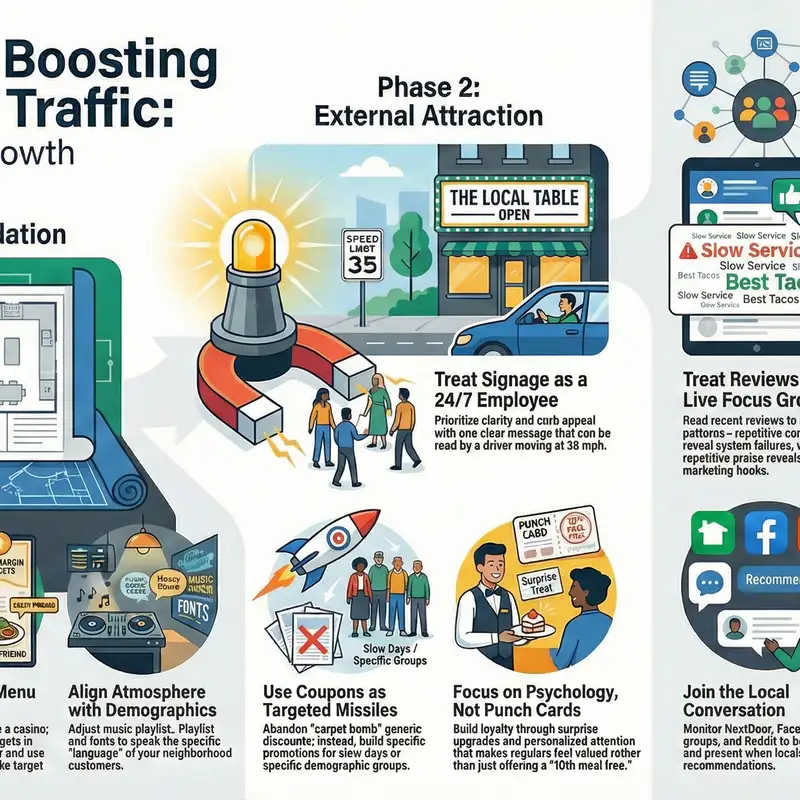
Penny:This is where we get to the 35 Miles per hour test.
Roy:This is my favorite piece of actionable advice in the whole report. It's so simple.
Penny:So walk us through it.
Roy:Most owners, they park out back. Or they stand on the sidewalk right in front of their sign. But that is not how your customers see you.
Penny:Right, they're driving by.
Roy:They're driving past at 35 miles per hour trying not to rear end someone. So the test is literal. Get in your car, drive past your own restaurant. What do you actually see?
Penny:Is it readable? Is it faded?
Roy:Is it cluttered with five different messages? I see it all the time. A sign that has the phone number, the website, we deliver, catering, try our soup.
Penny:And at speed it's just a blur.
Roy:It's visual noise. The rule is one clear message beats five competing ones and if your sign looks dirty or tired the customer assumes your kitchen is dirty and tired.
Penny:It's the cover of the book.
Roy:Is a 20 fourseven employee. If that employee was sloppy you'd fire them. Fix the sign.
Penny:Okay. Let's pivot to something every owner obsesses over. Loyalty. And that dreaded coupon drop.
Roy:Carpet bombing, as the report calls it.
Penny:Yeah. You open your mailbox, and it's just that sheet of newsprint with 20 different 20% off stickers.
Roy:And Roundtable argues this is basically an addiction for the owner and the customer.
Penny:How so for the owner?
Roy:When you send out those generic blasts, you are training your
Penny:But that's the
Roy:key, be specific. Don't use a carpet bomb, use a targeted missile. If Tuesday is dead, create a promo only for Tuesday. Don't give away your margin on a busy Friday night.
Penny:That makes so much sense. Why discount a seat you could have sold anyway?
Roy:Exactly. And then there's the other side of this, the loyalty cards, the punch card, buy 10, get one free.
Penny:I think I have about 12 of those in my car somewhere, all lost.
Roy:They're boring. They're transactional. The source says people don't stay loyal for a free $10 sandwich after spending a $100. They stay loyal because they feel valued.
Penny:So what's the alternative?
Roy:It's all about surprise and delight. Instead of a formal program, you just empower your staff to randomly comp an appetizer for a regular. Or you walk up to a table and say, hey, guys, desserts on me tonight.
Penny:That hits different. That feels like a relationship.
Roy:And here's the challenge roundtable gives: pick your top 20 regulars, write their names down, and this week do something unexpected for them. The ROI on that connection is infinitely higher than a piece of plastic.
Penny:I love that. It's so simple.
Roy:It's simple, but nobody does it.
Penny:Wait, I want talk about the sad desk lunch. This part of the case study is just so painfully real.
Roy:We have all been victims of the sad desk lunch.
Penny:You're at the office, it's 12:30, you've got thirty minutes, and you're eating a cold sandwich while staring at a spreadsheet. It's miserable.
Roy:And the tragedy is, maybe two blocks away, there's a restaurant with amazing hot food. But the person at the desk doesn't go there.
Penny:Why not?
Roy:Because they assume it will take too long or they just forget it's even there. This is what the source calls the five mile universe.
Penny:Meaning your entire world is just that five mile radius.
Roy:For a local spot, yes. And inside that five miles are hundreds of hungry people. The owner needs to go hunt for them.
Penny:This is where the idea of partners versus competitors comes in. This kind of blew my mind.
Roy:It's a total mindset shift. The owner used to see the sports bar down the street as competition.
Penny:But the bar didn't have a kitchen, right?
Roy:Exactly. They had a popcorn machine and a room full of hungry people drinking beer. That is not a competitor, that is a partner.
Penny:So what do they do?
Roy:Roundtable set up a deal, the pizza shop delivered right to the bar.
Penny:Boom! An instant new dining room.
Roy:Same with the hotel nearby that didn't have room service. The pizza shop became the unofficial room service. You're just finding people who are already hungry and connecting the dots.
Penny:It's hunting versus waiting for them to show up.
Roy:And you do this digitally too. On Nextdoor, in local Facebook groups.
Penny:But you have to be careful there, you can't just spam the group.
Roy:Oh, you'll get blocked immediately. Yeah. You have to be a neighbor, people always posting, Who has the best wings? Or Where can I take my family?
Penny:And that's your bat signal.
Roy:You jump in, or better yet, have a regular jump in, and you're helpful, you're present.
Penny:Which brings us to the final piece. The thing that keeps owners up at night. The reviews.
Roy:Yep. Google. The source of all anxiety. Most owners just doom scroll their own reviews at midnight and get angry.
Penny:Karen from Ohio said the ice was too cold one star.
Roy:Right. But Roundtable says stop taking it personally. Your reviews are a live focus group. It's free data.
Penny:But how do you separate the signal from the noise?
Roy:You look for patterns. If one person says the soup is cold, oh yeah whatever. If three people say the soup is cold in one month, you have a systems problem. Your warmer is broken or your process is too slow.
Penny:It's a diagnostic tool.
Roy:For the good stuff too. If everyone keeps mentioning your garlic knots, guess what your new marketing hook is? Stop trying to push the calamari. Listen to the data.
Penny:So if we step back and look at this entire case study, the margins, the menu, the sign what's the big meta lesson here? It feels like more than a checklist.
Roy:It is. It's a shift in identity. It's the difference between waiting and hunting.
Penny:Elaborate on that.
Roy:The restaurants that fail, they are the ones that wait. They unlock the door, turn on the radio, and just wait for the world to walk in. They're passive.
Penny:They're victims of that Tuesday afternoon silence.
Roy:Correct. But the ones that thrive. They hunt. They work on the business. They do their margins down to the penny.
Roy:They design the menu to guide the guest. They go out and find the hungry people at the sports bar.
Penny:They take control of their own destiny.
Roy:They realize the business is a machine and they're the mechanic. If it's broken, you don't just stare at it, you get the wrench and you fix it.
Penny:And I think that's a perfect place to remind our listeners if this conversation is hitting a little too close to home, if you're nodding along thinking, yeah, I have no idea what my contribution margin is.
Roy:Or I haven't really looked at my sign in five years.
Penny:Then you should probably know about Phil Davis and his team. This case study is from Roundtable Consulting Group. This is what they do.
Roy:They pop the hood and fix the engine. They get it. They know the dirty laundry and they know how to clean it.
Penny:So we've covered a lot, but I want to leave everyone with one final thought. Something to chew on when you're doing that 35 miles per hour loop around your own business.
Roy:What's that?
Penny:Go back to that map analogy. If your menu, and really your entire business is a map, are you leading your customers to the treasure? Or are you just letting them wander off a cliff?
Roy:That is the question.
Penny:Thanks for diving in with us.
Roy:See you next time.